
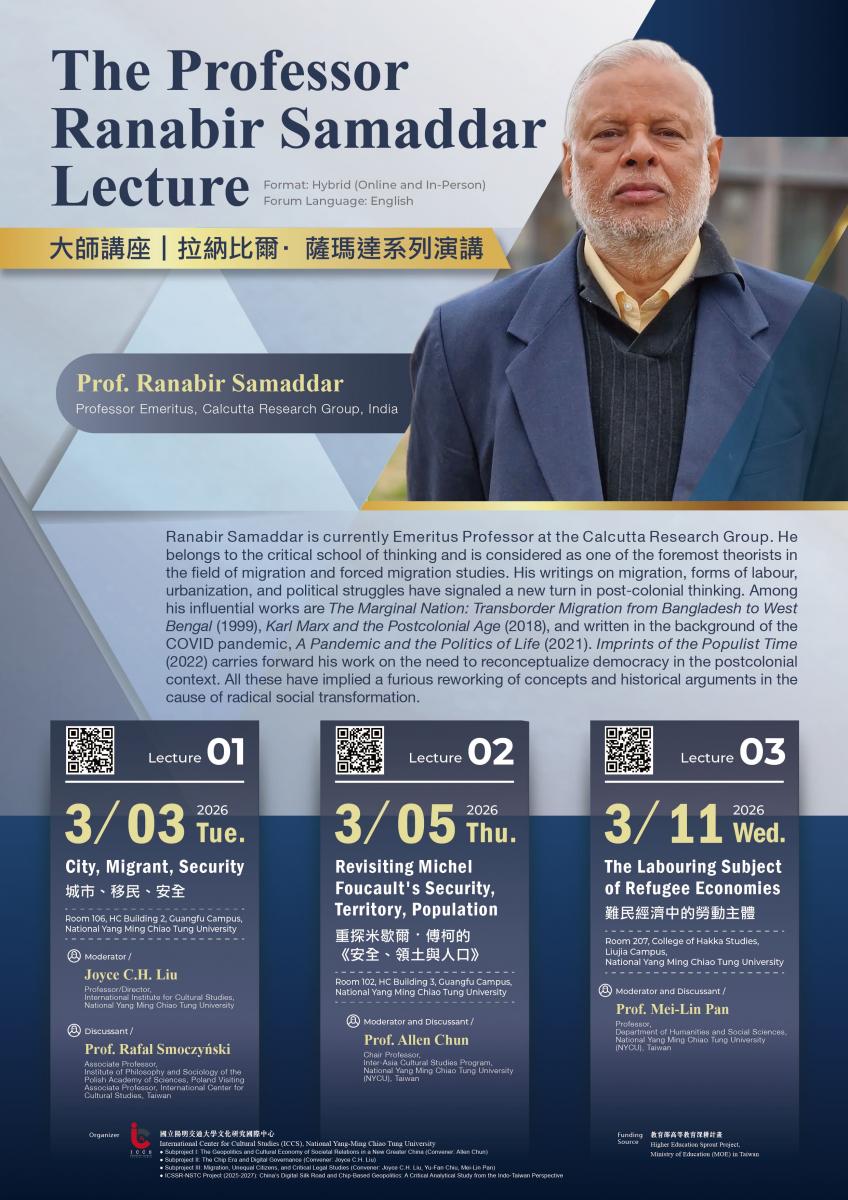
大師講座|拉納比爾・薩瑪達系列演講
2026-03-03 - 2026-03-03
Ranabir Samaddar (Professor Emeritus, Calcutta Research Group, India)
Hybrid (Online and In-Person)
Format: Hybrid (Online and In-Person)
Forum Language: English
Speakers: Ranabir Samaddar (Professor Emeritus, Calcutta Research Group, India)
Ranabir Samaddar is currently Emeritus Professor at the Calcutta Research Group. He belongs to the critical school of thinking and is considered as one of the foremost theorists in the field of migration and forced migration studies. His writings on migration, forms of labour, urbanization, and political struggles have signaled a new turn in post-colonial thinking. Among his influential works are The Marginal Nation: Transborder Migration from Bangladesh to West Bengal (1999), Karl Marx and the Postcolonial Age (2018), and written in the background of the COVID pandemic, A Pandemic and the Politics of Life (2021). Imprints of the Populist Time (2022) carries forward his work on the need to reconceptualize democracy in the postcolonial context. All these have implied a furious reworking of concepts and historical arguments in the cause of radical social transformation.
演講一|城市、移民、安全 City, Migrant, Security
Date and Time: Tuesday, March 3, 2026, from 10:10 to 12:00, Taipei Time (GMT+8)
Venue: Room 106, HC Building 2, Guangfu Campus, National Yang Ming Chiao Tung University
Moderator: Joyce C.H. Liu (Professor/Director, International Institute for Cultural Studies, National Yang Ming Chiao Tung University, Taiwan)
Discussant: Rafał Smoczyński (Associate Professor, Institute of Philosophy and Sociology of the Polish Academy of Sciences, Poland; Visiting Associate Professor, International Center for Cultural Studies, Taiwan)
Online Link: https://meet.google.com/qft-grew-mnu
Synopsis
This lecture examines the contemporary “Southern city” through the lived experiences of migrants, foregrounding the entanglements of security, violence, and urban governance. It explores how migrants are simultaneously rendered indispensable to the urban economy and treated as sources of risk, disorder, and crime. Focusing on sites such as migrant settlements, informal markets, streets, and universities, the lecture shows how discourses of crime and security legitimize policing, surveillance, and exclusionary regulatory practices that marginalize migrant populations.
At the same time, the lecture challenges a victim-centered narrative by highlighting migrants’ everyday practices of survival, including the formation of trust networks, solidarities, and practices of care and mutual protection. These informal and semi-formal arrangements enable migrants and lower-class residents to make collective claims to the city, contesting dominant property regimes and nationalist imaginaries.
Situating these dynamics within the broader transformations of neoliberal urbanism, the lecture argues that infrastructural reorganization produces a condition of permanent uncertainty rather than security. Migrant labor becomes an intolerable yet necessary element of the city’s extractive and rental economies. Finally, the lecture identifies these fragile practices of solidarity as “necessary utopias,” modest yet vital experiments in cosmopolitan futures that persist within insecure and violent urban spaces.
演講二|重探米歇爾・傅柯的《安全、領土與人口》Revisiting Michel Foucault's Security, Territory, Population
Date and Time: March 5, 2026, from 13:30 to 15:30, Taipei Time (GMT+8)
Venue: Room 102, HC Building 3, Guangfu Campus, National Yang Ming Chiao Tung University
Moderator and Discussant: Allen Chun (Chair Professor, Inter-Asia Cultural Studies Program, National Yang Ming Chiao Tung University, Taiwan)
Online Link: https://meet.google.com/mhg-uwpg-fbj
Synopsis
Michel Foucault delivered a series of lectures titled, "Security, Territory, Population," at the College de France in 1977–78. Much of this lecture series concerned city-making. Foucault showed how conjuncture functioned as a key to historical intelligibility in understanding the formation of a modern city. He demonstrated the three elements of its formation—security, territory, and population—coming together to constitute an axis in the history of modern governmentality. Reason of state was supplemented by reason of government. The city produced a new way to rule, which also entailed a new model of historical temporality for the new mode of governing.
Is this lecture series relevant today to understanding the neoliberal city, particularly the cities of the south? This discussion proposes to delve into that question and find new resonance in Foucault's ideas.
A city appears today as wicked as migrants arrive. It emerges with its gray skyline when seen from afar, either as migrants ready themselves to leave the ship or after trudging for days and nights when they reach the city's outermost post. At the same time, to the city these sojourners are suspect, with alien behaviour, manners, and customs, ready to bedevil and pollute the place. Drugs, gang warfare, smuggling, and continuous games of hide-and-seek paint a picture of impending disaster for the city. While crimes may happen elsewhere – in the city centre, near the port, at central stations, or in warehouses—the spectre of crime reaches the migrants’ hamlets, even if the crime did not originate there. In the bloody denouement crime occupies the central place in high-level talks and policy discussions at administrative headquarters, further marginalizing the migrants' hamlets—a situation that may encapsulate the city’s future in the twenty-first century. In this situation, the migrant waits for the storm to pass over, waits for a job or a relatively secure place to stay, or simply waits to contact people who can help them find work or a street corner to open a convenience store. The city’s space and time are continuously reconfigured for the migrant-in-waiting. Indeed, when a violent incident occurs the rhythm of time and space accelerates.
The way the migrant negotiates the hazards of an alien city reveals “uncertainty” as a feature of migrant life. This makes the city a bifurcated place. The city provides services assured by the city elders for its citizens. At the same time, there is also an illegal and uncertain city, if you like, whose denizens like creatures of an underground existence sneak into the open world to gather food and fodder, at the end of which they must recoil back to their underground existence. This is thus not a problem of “security”. We may replace that word with "insecurity," which stems from "uncertainty." These migrant experiences tell us of what one philosopher has described as “living dangerously”.
Strangely, but happily, these daily practices of survival also produce utopias - practices of a cosmopolitan future (such as "cities of refuge") - which often fail. Yet through the power of ideas these practices survive. Locating them is important. They are “necessary utopias.” To broach the phenomenon of necessary utopia we are of course going beyond Foucault.
演講三|難民經濟中的勞動主體 The Labouring Subject of Refugee Economies
Date and Time: Wednesday, March 11, 2026, from 13:30 to 15:30, Taipei Time (GMT+8)
Venue: Room 207, College of Hakka Studies, Liujia Campus, National Yang Ming Chiao Tung University.
Moderator and Discussant: Mei-Lin Pan (Professor, Department of Humanities and Social Sciences, National Yang Ming Chiao Tung University, Taiwan)
Online Link: https://meet.google.com/gjo-gicw-hdg
Synopsis
Most writings on refugee economy or the immigrant economy refer to changes in the immigrant labour absorption policies of the Western governments. In these writings the refugee economy or the immigrant economy never features directly; refugees are seen as economic actors in the market. But we do not get a full picture of why capitalism in late twentieth or early twenty first century needs these refugee or immigrant labour as economic actors. The organic link between the immigrant as an economic actor and the global capitalist economy seems to escape the analysis in these writings. Yet, if immigration policies produce precarious labour, this has general significance for the task of theorising the migrant as living labour. The question of the production of living labour is important because it puts in a critical perspective the necessity of the states and the international regime of protection to synchronise the economic and the political strategies of protection. Yet the disjuncture between the two strategies of protection is not only typical of the postcolonial parts of the globe, the disjuncture is evident in the developed countries. Globally, one can say, capital sets in motion movements of labour within a specific field of force that dictates how and why migrant labour is to be harnessed, disciplined, and governed (for instance the dominant presence of immigrant labour in logistics, health care, agriculture, etc.), and that shapes the links between “strategies” (that control migrants once they are in motion) and the mechanisms that set these movements in motion.
Organizer
國立陽明交通大學文化研究國際中心 International Center for Cultural Studies (ICCS), National Yang-Ming Chiao Tung University
Funding Source
教育部高等教育深耕計畫
Higher Education Sprout Project, Ministry of Education (MOE) in Taiwan
近期活動 Recent Activities
.png)
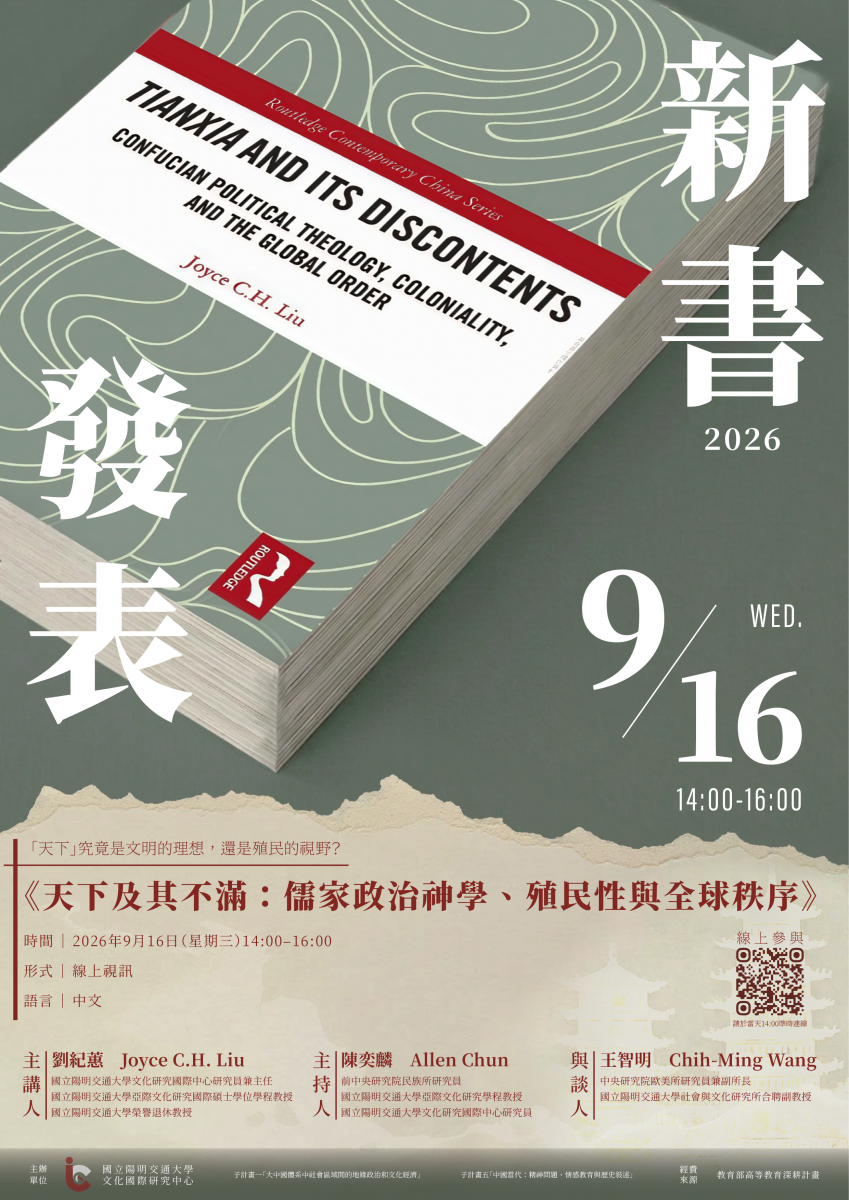
Book Launch Event | Tianxia and Its Discontents: Confucian Political Theology, Coloniality, and the Global Order
2026-09-07 - 2026-12-31
more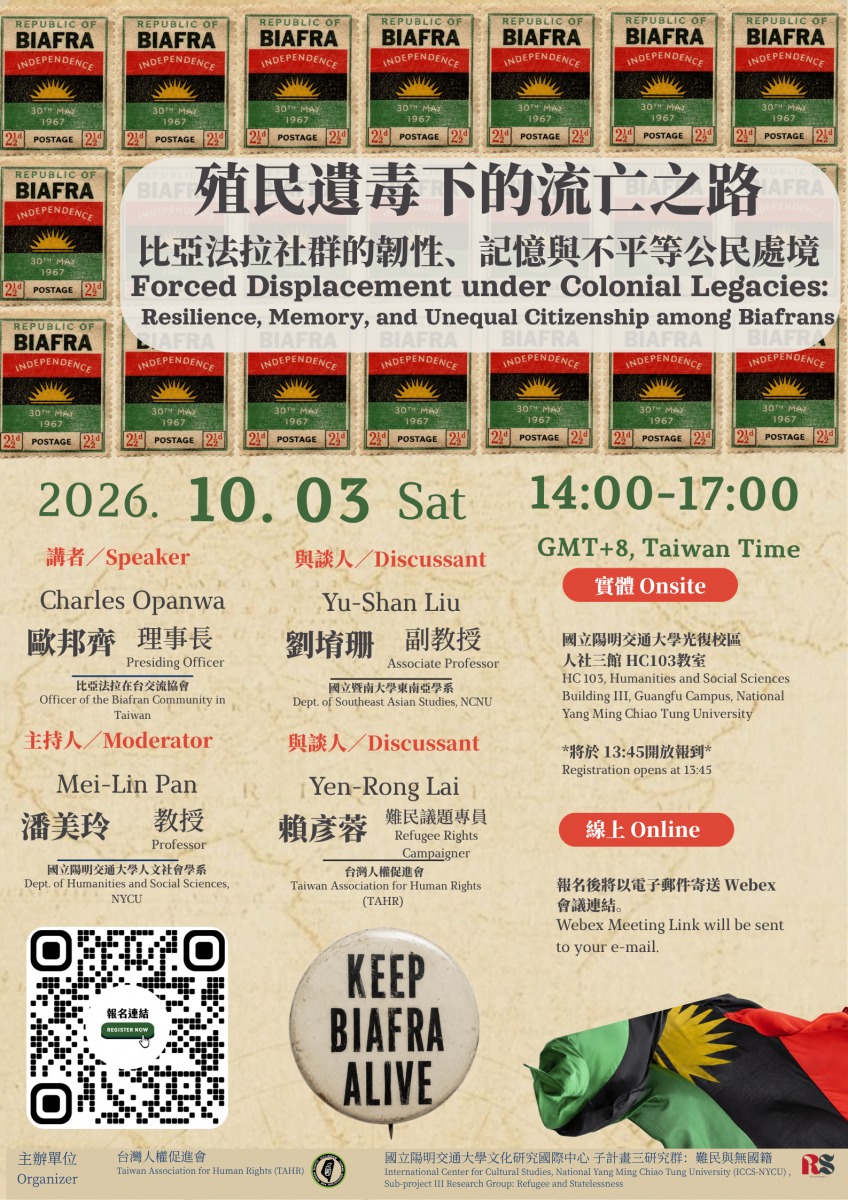
Lecture | Forced Displacement under Colonial Legacies: Resilience, Memory, and Unequal Citizenship among Biafrans
2026-09-10 - 2026-12-31
more.jpg)