
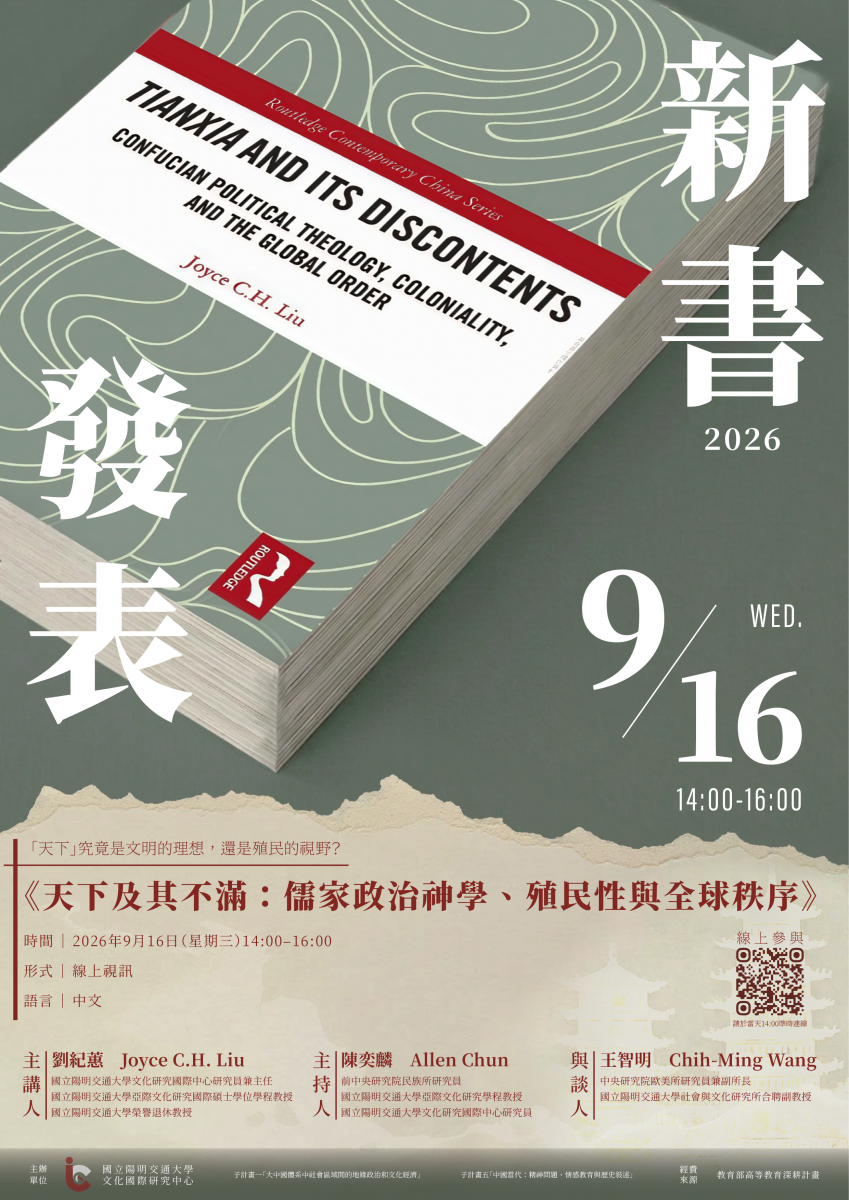
Book Launch Event | Tianxia and Its Discontents: Confucian Political Theology, Coloniality, and the Global Order
2026-09-07 - 2026-09-07
Book Launch Event | Tianxia and Its Discontents: Confucian Political Theology, Coloniality, and the Global Order
Author: Joyce C.H. Liu
Publisher: Routledge, June 2026
Event Details
Date & Time: Wednesday, September 16, 2026 | 14:00–16:00 (TST)
Format: Online via Google Meet
Link: https://meet.google.com/tik-ooyc-zgm (Please join on time at 14:00)
Language: Mandarin Chinese
Speakers & Panelists
Speaker: Joyce C.H. Liu
Chair Professor and Director, International Center for Cultural Studies (ICCS), National Yang Ming Chiao Tung University (NYCU)
Professor, International Master’s Program in Inter-Asia Cultural Studies, NYCU
Emeritus Professor, NYCU
Host: Allen Chun
Research Fellow, International Center for Cultural Studies, NYCU
Discussant: Chih-Ming Wang
Research Fellow and Associate Director, Institute of European and American Studies, Academia Sinica
About the Book
Is "Tianxia" a civilizational ideal, or a colonial vision?
In recent years, the "Tianxia system" has been widely promoted as a Confucian cosmopolitan alternative to the Western international order. Tianxia and Its Discontents offers a critical response to this narrative. The author, Joyce C.H. Liu, argues that Tianxia is not an inclusive civilizational framework, but rather a political-theological mechanism that uses the "Mandate of Heaven" to legitimize imperial order. The dual configuration of Confucianism and Legalism—combining Confucian moralizing discourse with Legalist techniques of discipline—constitutes the governing core of the imperial Tianxia: cosmicization, moralization, universalization, hierarchical differentiation, disciplination, and the concept of "having no outside" (wuwai). While "having no outside" ostensibly implies universal inclusion, it operates in reality at the cost of erasing difference and dissent.
The book further traces the historical transformations of Tianxia: from imperial ritual and the tributary system, through the crucible of colonial modernity, to the digital Tianxia of the 21st century. Algorithmic surveillance, the governance interfaces of mega-platforms, and the global expansion of digital infrastructure reassemble the governing logic of the imperial Tianxia in technological forms, perpetuating coloniality under new guises.
In response to this structure, the book engages with the concept of yu ("remainder" or "excess") from Fang Yizhi's Yi Yu to open an alternative position of thought. Yu is not a fixed residual beyond the order, but an ongoing emergence within mutable, interactive, and intricate relations—appearing precisely where the central vision fails to subsume. Fang Yizhi's method of "understanding principles through things" (yin wu zhi ze) discerns invisible forces and rationales from the encounters between objects, loosening the singular, universalized vision of Tianxia.
Finally, the book turns to artistic decolonization: Xu Bing redeploys waste and traces of labor; Wu Tien-chang externalizes the internalized shame and trauma of colonial history onto the surface skin; and Chen Chieh-jen summons the lives excluded by the global capitalist order through the figures of female factory workers and migrant laborers. All three artists mobilize materiality, memory, and perception from the position of yu, making visible once again the lived experiences suppressed by colonial structures.
Situated at the intersection of Confucian political philosophy, postcolonial theory, political theology, and cultural studies, this book provides an original conceptual framework. It offers profound academic significance for understanding contemporary Chinese global discourse and the future trajectories of Asian critical theory.
About the Author
Joyce C.H. Liu holds a Ph.D. in Comparative Literature from the University of Illinois at Urbana-Champaign. She is currently a Research Fellow and Director of the International Center for Cultural Studies (ICCS) at National Yang Ming Chiao Tung University (NYCU). Her research interests encompass political philosophy, psychoanalysis, visual culture, and Chinese political thought. She has long been committed to combining critical theory with intellectual history to explore the formation of East Asian modernity, the historical transformation of Chinese political thought, and its intersections with the contemporary global order, digital governance, and the politics of infrastructure.
She is a recipient of the NSTC (formerly MOST) Outstanding Research Award and multiple academic publication honors. In recent years, she has directed the Ministry of Education (MOE) Higher Education Sprout Project "Conflict, Justice, Decolonization" and the CHCI–Mellon Global Humanities Research Project "Migration, Logistics, and Unequal Citizenship in Contemporary Global Contexts," while actively promoting the Transit Asia Research Network (TARN).
Selected Publications:
Orphan, Goddess, and the Writing of the Negative (2000)
The Topology of Mind (2011)
Two Divided into One (2020)
The Topology of Mentalities (2023)
Tianxia and Its Discontents: Confucian Political Theology, Coloniality, and the Global Order (Routledge, 2026)
Organizer & Funding
Organizer: International Center for Cultural Studies, NYCU
Sub-project 1: "Geopolitics and Cultural Economy of Social Regions in the Greater China System"
Sub-project 5: "Contemporary China: Psychic Questions, Affective Education, and Historical Narratives"
Funding: Higher Education Sprout Project, Ministry of Education (MOE)
近期活動 Recent Activities
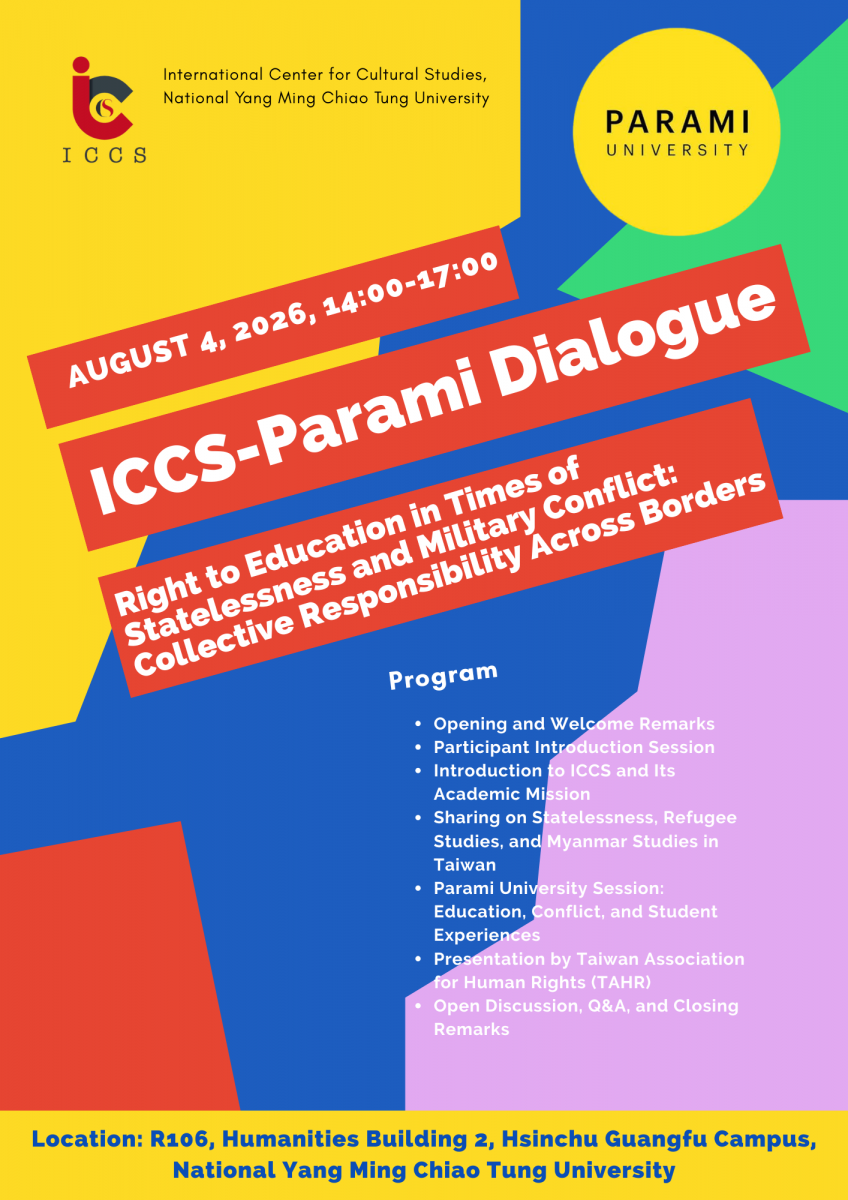
ICCS × Parami University Dialogue : Right to Education in Times of Statelessness and Military Conflict: Collective Responsibility Across Borders
2026-08-04 - 2026-10-10
more.png)
Book Launch Event | Tianxia and Its Discontents: Confucian Political Theology, Coloniality, and the Global Order
2026-09-07 - 2026-09-07
more.jpg)