
Report | on the Lecture “Global Production Networks, the State, and Migrant Workers: Governing Labour in the Semiconductor Industry”
2026-05-27
Report | on the Lecture “Global Production Networks, the State, and Migrant Workers: Governing Labour in the Semiconductor Industry”
Seeing Migrant Labour Behind the Semiconductor Industry through Global Production Networks
Moderator: Assoc. Prof. Yu-Fan Chiu | School of Law, National Yang Ming Chiao
Tung University
Keynote Speaker: Asst. Prof. Ting-Chien Chen|Department of Geography, National Kaohsiung Normal University
Discussants: Prof. Mei-Lin Pan|Department of Humanities and Social Sciences,
National Yang Ming Chiao Tung University & Dr. Chiung-Chih Chen | Postdoctoral
Research Fellow, Resilient and Sustainable Development Center, National Tsing Hua University
Authors: Wu Hui-Chen & Chan Yao-Chi|LL.M. Candidate, School of Law, National Yang Ming Chiao Tung University
Subproject 3: Migration, Unequal Citizens, and Critical Legal Studies
Principal Investigator|Chiu Yu-Fan
🌏 On May 4, 2026, National Yang Ming Chiao Tung University hosted the lecture “Global Production Networks, the State, and Migrant Workers: Governing Labour in the Semiconductor Industry,” featuring Asst. Prof. Ting-Chien Chen from National Kaohsiung Normal University as the speaker.
💫 Asst. Prof. Chen approached the issue from the perspective of transnational labor regimes, guiding the audience to reconsider how the success of Taiwan’s semiconductor industry relies on a multi-scalar labor regime jointly constituted by enterprises, the state, brokers, and migrant workers.
Behind the Upgrading of the Semiconductor Industry: Migrant Workers as Indispensable Frontline Labor
Taiwan plays an important foundry role in the global semiconductor production chain. From chip design and manufacturing to packaging and testing, Taiwan has developed a highly specialized industrial system. Taking the Hsinchu Science Park and the Nanzih Export Processing Zone, currently known as the Kaohsiung Nanzih Technology Industrial Park, as examples, the Hsinchu Science Park is primarily concentrated on chip design and manufacturing, while the Nanzih Export Processing Zone focuses mainly on packaging and testing. According to 2018 data, migrant workers accounted for approximately 5.7% of the workforce in the Hsinchu Science Park, while the proportion reached 13.2% in the Nanzih Export Processing Zone.
This shows that although the semiconductor industry is often regarded as a high-tech and high-value-added industry, its production operations still rely heavily on a large number of frontline operators and migrant workers. In particular, the development of the Nanzih Export Processing Zone reflects the transformation of Taiwan’s technology-sector labor structure. In its early period, the zone was dominated by labor-intensive industries such as garments and electronic components, but it later gradually transformed into a semiconductor packaging and testing hub. As education became more widespread in Taiwan and local workers became less willing to enter factory work, migrant workers gradually became an indispensable source of labor within the industrial park.
Migrant Workers’ Labour Conditions Are Not Determined by a Single Enterprise, but Shaped by Multiple Scales
The core concept of this lecture was the “multi-scalar labor regime.” Asst. Prof. Chen reminded the audience that to understand migrant workers’ working conditions in Taiwan’s technology industry, one cannot focus solely on a single factory or an individual employer’s management practices. Instead, these conditions must be examined simultaneously at the global, national, and local levels.
At the global level, transnational brand buyers exert commercial pressure on Taiwanese contract manufacturers through orders, delivery deadlines, and corporate codes of conduct. At the same time, NGOs and private governance mechanisms such as the RBA also attempt to intervene in labor governance within supply chains. At the national level, the Employment Service Act, visa policies, and migrant worker quota systems regulate how migrant workers enter Taiwan, how they work, and whether they may change employers. At the local level, labor governance involves how contract manufacturers, private brokers, and local labor markets jointly arrange migrant workers’ work, housing, and everyday lives.
Within global production networks, although Taiwanese technology manufacturers possess strong technological capabilities, most remain in the position of contract manufacturers. They must respond to brand companies’ demands for short lead times, zero inventory, and just-in-time production. When this production model is reflected at the frontline labor site, it results in 12-hour shifts, non-stop production lines, and intense time pressure. In other words, the labor intensity borne by migrant workers cannot simply be attributed to the management choices of individual enterprises. Rather, it is the result of the interaction among global supply chain competition, national migrant labor policies, and local employment systems.
Labor Market Intermediaries Do More Than Match Workers with Jobs; They Also Produce Labor Market Segmentation
Although Taiwan has had a direct hiring system since 2007, most migrant workers still primarily come to Taiwan through private brokers. These brokers do not merely “introduce jobs”; they are important actors who actively participate in transnational migration, employer matching, dormitory arrangements, and the construction of labor relations.
Brokers shape labor-management relations and further intensify segmentation within the migrant labor market. Before arriving in Taiwan, migrant workers are often already tied to specific employers and dormitories. In addition, their contract periods may last from three to twelve years, limiting their mobility and bargaining power in the local labor market. Compared with Taiwanese workers, who can switch jobs and compare working conditions across different factories, migrant workers who wish to change employers usually face higher institutional barriers and more limited options.
Furthermore, although private governance mechanisms such as the RBA promote a “zero-fee” policy requiring suppliers to reduce the recruitment-cost burden on migrant workers, gaps remain in practice. Many frontline migrant workers do not know whether their companies participate in RBA audits, nor do they necessarily know whether their working environments are protected by relevant standards. This shows that while transnational private governance may produce some supervisory effects, it does not necessarily translate into labor protections that migrant workers can actually experience.
Migrant Workers Are Caught between Social Upgrading and Social Downgrading
When migrant workers migrate across borders to work in Taiwan’s technology industry, are they experiencing social upgrading or social downgrading? From the perspective of wages, migrant workers may indeed earn higher incomes than they would in their home countries. However, from the perspectives of job security, career development, social networks, and life stability, they may also simultaneously experience downgrading.
Migrant workers are often caught between social upgrading and social downgrading. Their job quality may improve because of higher income, but their job security and freedom of mobility may decline. Taking Filipino migrant workers as an example, some originally worked in export processing zones in the Philippines and later moved to export processing zones in Taiwan. On the surface, their wages increased. At the same time, however, they lost their original social networks and entered a labor regime constrained by employers, brokers, and state institutions. Therefore, one cannot simply conclude that migrant workers have achieved social upgrading merely because they earn more money.
Nevertheless, migrant workers are not entirely passive laborers. They compare institutional costs, wage conditions, and career-development possibilities across different countries, industries, and types of work. For example, they may choose among Taiwan, Hong Kong, South Korea, care work, or industrial work. These mobility strategies show that migrant workers still possess agency, but this agency is often exercised within a highly constrained institutional environment.
---------------
Expanding the Social Imagination of Industrial Upgrading from the Perspective of Global Value Chains
💫 Discussant Professor Mei-Lin Pan of the Department of Humanities and Social Sciences at National Yang Ming Chiao Tung University began from the research traditions of global commodity chains and global value chains. She supplemented the lecture by explaining how it brings “migrant workers” into global production network analysis, which has traditionally centered on industries and firms.
Past global value chain research has mostly focused on transnational industrial division of labor, supply chain governance, and industrial upgrading. Yet the global division of labor in the semiconductor industry also involves how labor moves across borders and enters local production sites in Taiwan. “Migrant workers” are not merely frontline operators who fill labor shortages; they are important actors situated at the intersection of global industrial division of labor and transnational labor migration.
In the past, Taiwanese firms established factories overseas and used local labor. Today, however, transnational labor is being brought into Taiwanese factories, creating new connections between the global and the local. This also means that “governance” and “upgrading” cannot remain limited to firm competitiveness or technological improvement. They must also incorporate analysis of labor conditions, migrant workers’ rights, and social consequences.
Therefore, the upgrading of the semiconductor industry should also be understood within a broader context of social value. In the past, mechanisms such as the Fair Labor Association, the SA8000 social responsibility standard, and social responsibility audits attempted to respond to labor oppression in transnational supply chains. Today, migrant labor governance further reminds us that industrial upgrading should not be evaluated only in terms of output value and costs. It should also make visible the workers who sustain industrial operations, as well as the rights and positions they deserve.
Under the Zero-Fee Principle, Recruitment Costs Should Not Simply Be Shifted to a Single Actor
💫 Discussant Dr. Chiung-Chih Chen, a postdoctoral researcher at the Center for Sustainable and Resilient Development at National Tsing Hua University, drew on his research experience with the Philippine brokerage industry and transnational labor migration systems to bring the discussion back to the issue of reforming Taiwan’s migrant worker system.
As the “zero-fee principle” becomes a trend in international supply chain governance, the previous model in which migrant workers bore high recruitment fees is increasingly being challenged by external pressures, including RBA standards, requirements imposed by international brand companies, and U.S. regulations on forced labor.
When recruitment fees are gradually shifted to employers, the issue is not merely “who pays.” For enterprises, refunding recruitment fees already paid by migrant workers and bearing recruitment costs that vary significantly across countries of origin may indeed create new operational pressures. However, if the cost is merely shifted from migrant workers to employers without simultaneously reviewing broker fee structures, direct hiring channels, and the enforcement capacity of the Taiwanese government, reform may remain only a redistribution of costs, rather than a genuine improvement of the transnational recruitment structure.
Therefore, as the demand for employers to pay recruitment costs increases, the direct hiring center, which has historically been difficult to promote, may reemerge as an institutional necessity in this context.
More broadly, if international brand companies require suppliers to implement RBA standards and comply with zero-fee and fee-reimbursement requirements, yet do not share governance costs through pricing, order terms, or procurement practices, pressure may continue to be transferred downward. This also shows that supply chain labor governance should not merely require suppliers to absorb costs. Instead, it should reconsider how brand companies, employers, brokers, and the state can jointly share responsibility for reforming the migrant worker recruitment system.
-------------------
The lecture as a whole allowed us to see that the global competitiveness of Taiwan’s semiconductor industry is not supported only by technology, capital, and industrial policy. It is also built upon the everyday frontline labor of transnational migrant workers. Migrant workers’ labor conditions are shaped not only by the pressures of short lead times and flexible production imposed by global brands, but also by national visa and quota systems, private broker matching, RBA audit mechanisms, and local factory management practices.
It is worth noting that in recent years, transnational labor governance has also gradually shown a trend toward the “return of state regulation.” Through new-generation free trade agreements, such as the EU–Vietnam Free Trade Agreement, as well as Germany’s Supply Chain Due Diligence Act and the EU Corporate Sustainability Due Diligence Directive, labor rights protection has begun to be linked with market access conditions.
This means that the supply chain governance model, which in the past relied more heavily on voluntary corporate standards and private audits, is gradually being incorporated into public-law regulation and sanction mechanisms. As a result, the state is returning to the negotiating table of transnational labor rights governance.
Therefore, to truly understand labor governance in the technology industry, we cannot look only at industrial upgrading, economic growth, and global competitiveness. We must further ask: In global production networks, who bears the costs of flexible production? Whose mobility and bargaining power are restricted? And how do migrant workers seek better possibilities for life and work under constrained institutional conditions? These questions are the most important reflections brought to us by this lecture.
近期新聞 Recent News
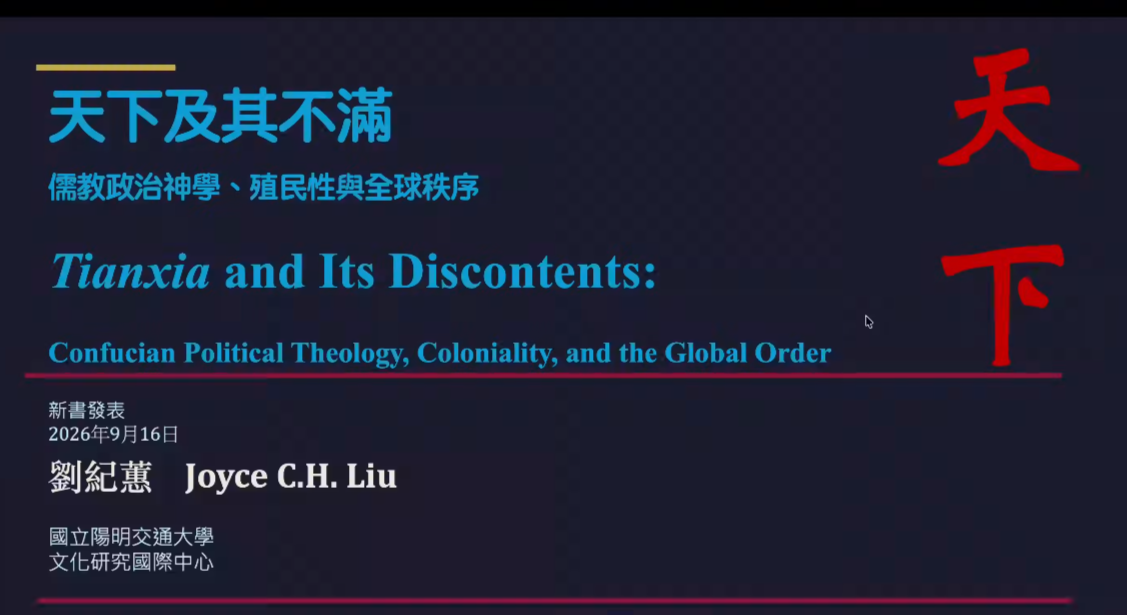
Tianxia and Its Discontents: Confucian Political Theology, Coloniality, and the Global Order (Routledge, 2026b)
2026-10-01
more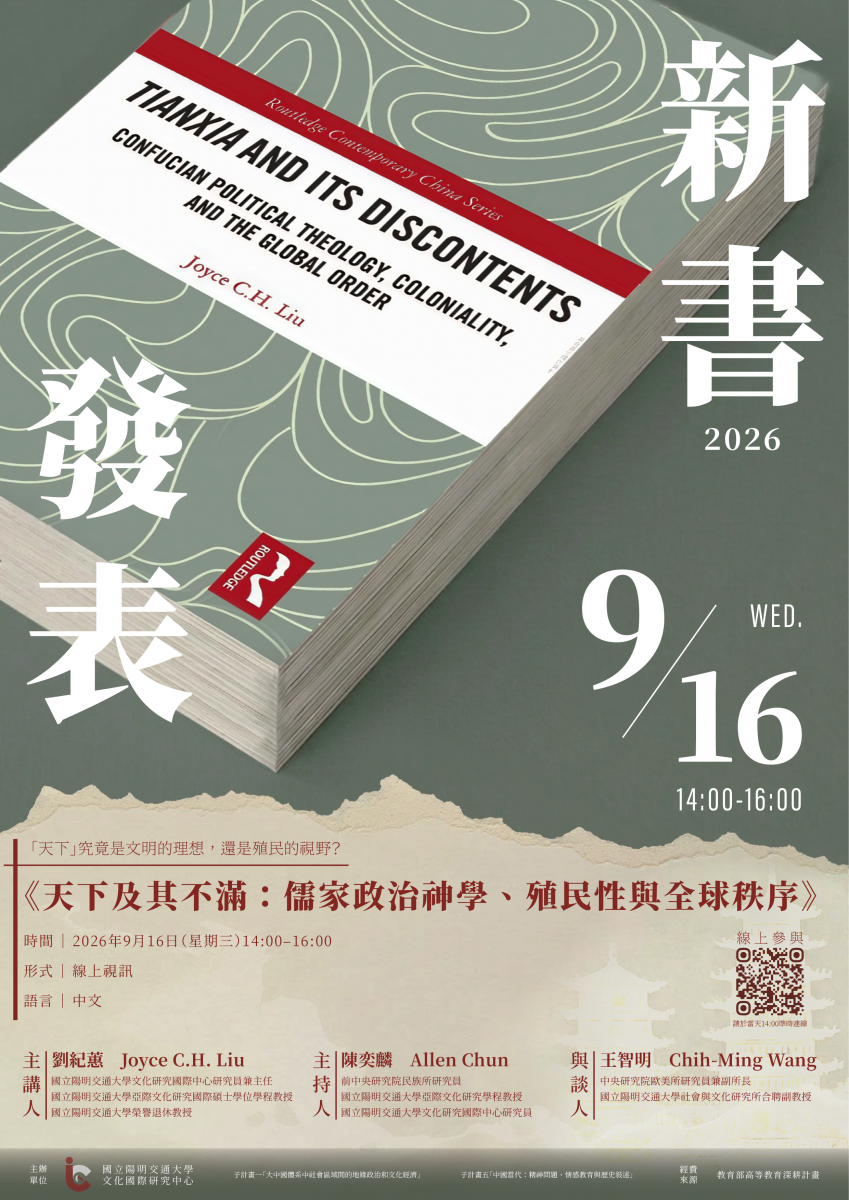
report|Tianxia and Its Discontents: Confucian Political Theology, Coloniality, and the Global Order (Routledge, 2026b)
2026-09-29
more.jpg)
.jpg)
