近期出版 Recent Publication
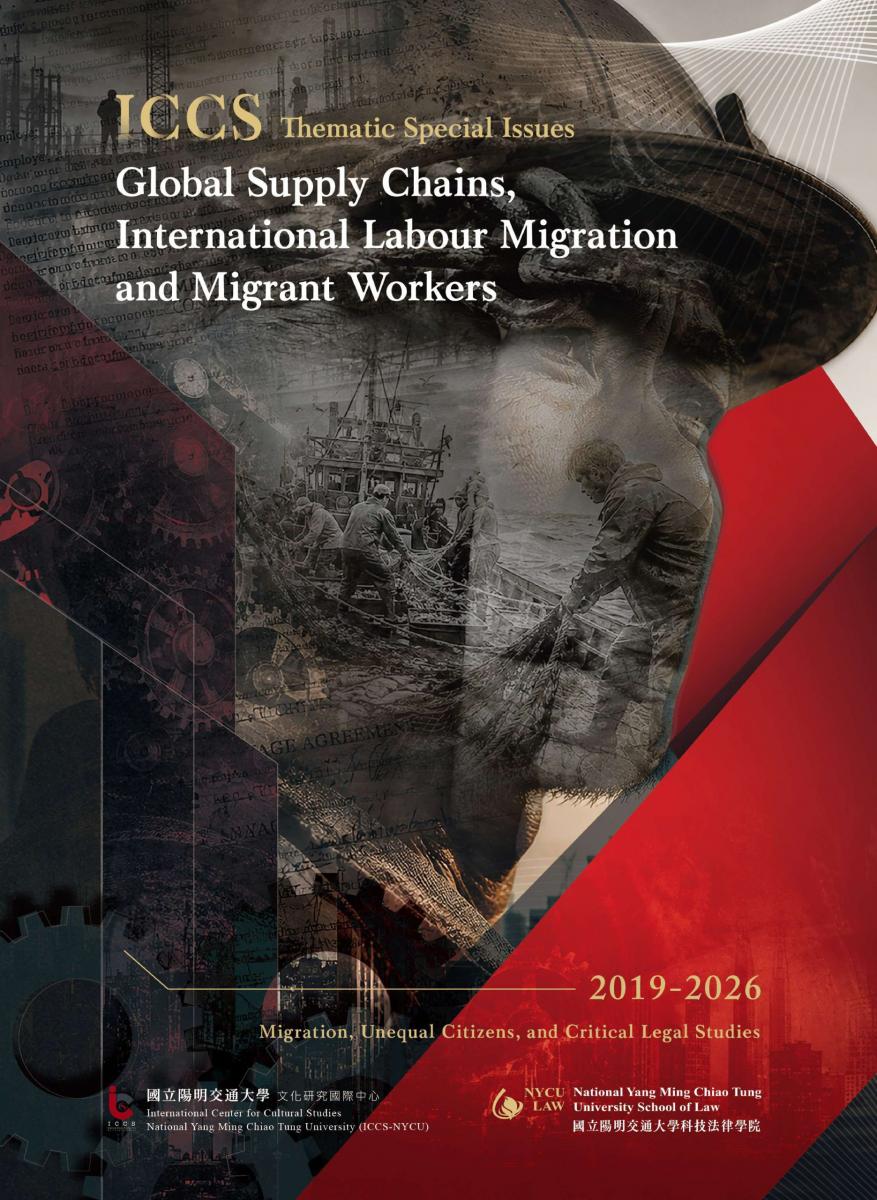
ICCS Thematic Special Issues: Global Supply Chains, International Labour Migration and Migrant Workers (2019–2026) — Migration, Unequal Citizens, and Critical Legal Studies
more“Contemporary China Keywords” Collaborative Writing Workshop II-“Man Can Conquer Nature” (人定勝天).
2026-10-27
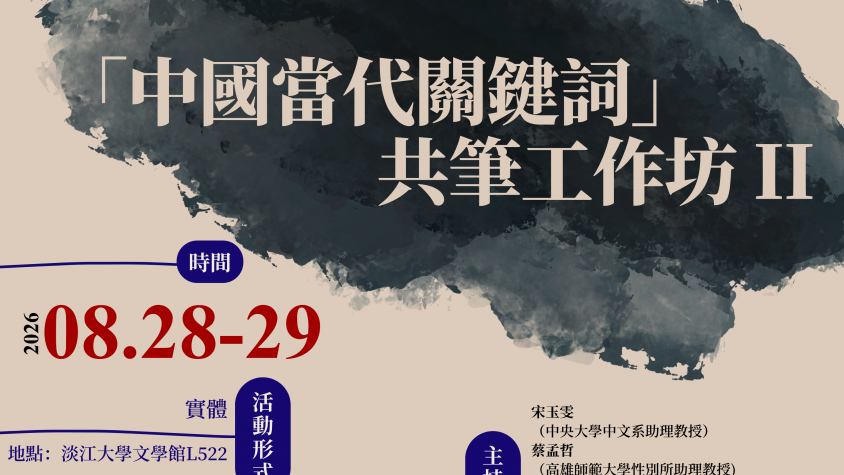
“Contemporary China Keywords” Collaborative Writing Workshop II
Date: August 28–29, 2026
Venue: Room L522, Literature Building, Tamkang University
Format: In-person
Organizers: Contemporary China Research Project, International Center for Cultural Studies (ICCS), National Yang Ming Chiao Tung University; Department of Chinese, Tamkang University
Abstract
The “Contemporary China Keywords” Collaborative Writing Workshop seeks to use “keywords” as a methodological approach to understanding contemporary China. Rather than simply collecting popular expressions or cultural phenomena, the workshop focuses on the two mutually constitutive concepts of “China” and “the contemporary.” Through a series of keywords, it seeks to map the historical experiences, institutional characteristics, affective structures, and cultural imaginaries of contemporary China.
Temporally, we take 1949 and the period from 1978 to 2000 as two important historical starting points for understanding “contemporary China.” We also treat “China” itself as a concept that requires renewed scrutiny. Our objective extends beyond examining the meanings of individual words. Instead, we approach each keyword as an entry point into the historical, literary, social, and intellectual contexts through which contemporary China can be understood.
Through collaborative writing and collective discussion, we hope to gradually develop a shared conceptual vocabulary for understanding contemporary China, map its complex landscape, and establish a body of literature and research resources that can serve as a reference for future scholarship.
Moderators
Song Yuwen, Assistant Professor, Department of Chinese, National Central University
Tsai Meng-Che, Assistant Professor, Graduate Institute of Gender Studies, National Kaohsiung Normal University
Huang Wen-Chien, Associate Professor, Department of Chinese, Tamkang University
Wang Chih-Ming, Research Fellow, Institute of European and American Studies, Academia Sinica; Convener of the Contemporary China Subproject
Keynote Speaker
Luo Xiaoming, Associate Professor and Chair, Department of Humanities, Shanghai University
Man Can Conquer Nature
Author: Lin Chieh-ju, Postdoctoral Researcher, Institute of Chinese Literature and Philosophy, Academia Sinica
The theme of the third session of the workshop was “Civilizational Hierarchies.” The presenter, Lin Chieh-ju, a postdoctoral researcher at the Institute of Chinese Literature and Philosophy, Academia Sinica, proposed the keyword “Man Can Conquer Nature” (人定勝天).
Dr. Lin first introduced his doctoral dissertation, which examined how contemporary Chinese fiction responds to concepts such as China’s rise, the Chinese Dream, and national rejuvenation. He argued that fiction reflects how, in its pursuit of prosperity and power, China must also confront historical trauma, social ills, and the spiritual maladies of its time. Tracing this perspective further back, since the founding of the People’s Republic of China, the state has continuously adopted different strategies to overcome limitations imposed by resources, technology, and conditions for development. From this perspective, “Man Can Conquer Nature” offers an important lens through which to examine the logic of contemporary China’s development. Its meaning and forms of practice have evolved in accordance with the state’s development goals at different historical stages.
Dr. Lin examined the meaning of “Man Can Conquer Nature” across three periods. During the Mao Zedong era, the goal of surpassing Britain and catching up with the United States within a short period fostered a strong voluntarist mentality, in which nature was regarded as something that could be overcome and conquered. Mao’s political mobilization drew on the allegory of “The Foolish Old Man Who Removed the Mountains,” emphasizing the spirit of struggle between humanity and nature, as well as the agency of the peasant masses in transforming objective conditions. After the launch of reform and opening-up, the focus shifted toward economic development and material consumption. Accordingly, “Heaven” no longer represented nature alone, but also encompassed resources that could be reallocated and transformed in the course of economic development. The obstacles to be overcome were now the constraints and scarcity encountered in the process of modernization.
Entering the new millennium, with the development of the internet, digital technologies, and artificial intelligence, the human being has gradually evolved from a purely embodied entity into a hybrid being integrated with technology. “Heaven,” meanwhile, has come to represent the uncontrollable factors associated with technological development. How the Chinese Communist Party can bring technology within the realm of control while gaining an advantage over other countries has thus become a new question in the technological age. The robot performances featured in CCTV’s Spring Festival Galas over the past two years also offer an opportunity to consider how a balance can be struck between control and transcendence, thereby creating new possibilities.
During the discussion, Professor Huang Wen-chien pointed out the difficulty of applying a single keyword to accurately capture China’s circumstances across different historical stages. While “Man Can Conquer Nature” was an effective term during the Mao era and the early period of reform and opening-up, China’s main competitor since the turn of the millennium has arguably been the West, particularly the United States. This raises concerns about whether the concept remains appropriate when the two sides are not conceptually equivalent, an issue that warrants further consideration. Professor Luo Xiao-ming extended this line of inquiry, asking how the position of the “human” should be defined in contemporary China, given the significant improvements in its overall conditions. This question, she suggested, also leaves room for further exploration. Finally, Professor Wang Chih-ming synthesized the keywords presented that day and proposed several possible ways of categorizing them. He suggested that “Man Can Conquer Nature” could be situated within the framework of “Mobility and Labor,” or examined through the concept of the “state” to understand how this keyword emerged.
近期新聞 Recent News
“Contemporary China Keywords” Collaborative Writing Workshop II-“Man Can Conquer Nature” (人定勝天).
2026-10-27
more