
Report|Legal Exclusion of Migrant Workers and Forced Labor Risks in Taiwan: A Focus on tshe Distant Water Fishing Industry
2025-12-10
Date:December 10, 2025 (Wednesday), 13:30–16:00 (GMT+8, Taiwan Time)
Venue : 陽明交通大學光復校區管理二館1069室(NYCU, Hsinchu, Taiwan, Management Building 2, Room 1069)
Moderator : Assoc. Prof. Bo-Shone Fu 傅柏翔副教授/國立台北大學法律學院(College of Law, National Taipei University)
Keynote Speakers : Assoc. Prof. Yu-Fan Chiu 邱羽凡 副教授(國立陽明交通大學科技法律學院; School of Law, National Yang Ming Chiao Tung University)
Report by Ping-Chi Chen (Master’s Student, Graduate Institute of Technology Law, National Yang Ming Chiao Tung University)
Event Info:LINK
Event photo:LINK
Event viedo: https://youtu.be/
Responses and Reflections from Taiwan’s Perspective
Associate Professor Yu-Fan Chiu responded to Professor Jennifer Gordon’s lecture by examining Taiwan’s position in debates on forced labor and supply chain human rights. She noted that despite long-standing discussions, forced labor had received limited policy attention in Taiwan until recent cases in the bicycle industry brought the issue into public focus.
Professor Chiu emphasized that the lecture was particularly relevant for Taiwan, as it not only identified structural problems but also highlighted future policy directions. Addressing supply chain human rights risks requires coordinated efforts by governments and corporations, while the role of trade unions remains important yet institutionally constrained.
Divergent Roles of Export-Oriented Economies
Professor Chiu stressed that Taiwan’s export-oriented economy faces different pressures from major consumer countries such as the United States. Given Taiwan’s dependence on access to international markets, forced labor allegations pose heightened trade and regulatory risks. Although the discussion centered on the seafood sector, she emphasized that forced labor risks extend across many migrant labor–dependent industries.
Misconceptions of Forced Labor and Gaps with International Standards
Professor Chiu observed that the public often equates forced labor with physical violence. However, under ILO standards, forced labor also includes debt bondage, wage withholding, excessive overtime, and abusive working and living conditions, precisely the indicators most frequently overlooked in Taiwan.
Limits of Criminal Law and Structural Blind Spots
Taiwan currently relies primarily on criminal law to address forced labor, but its high threshold results in many cases being treated merely as labor disputes. Professor Chiu cited cases in the distant water fishing industry where prolonged wage non payment was not recognized as forced labor, revealing misalignment with international standards.
Exclusion from Labor Standards and Abusive Working Conditions
She further linked forced labor risks to policy choices that exclude migrant workers in sectors such as distant water fishing from core labor protections, allowing abusive conditions to be systematically reproduced.
Policy Reform as a Preventive Strategy
Professor Chiu concluded that effective prevention requires aligning domestic understanding with ILO standards, establishing non-criminal early intervention mechanisms, and reforming policies that structurally enable abusive labor conditions.
近期新聞 Recent News
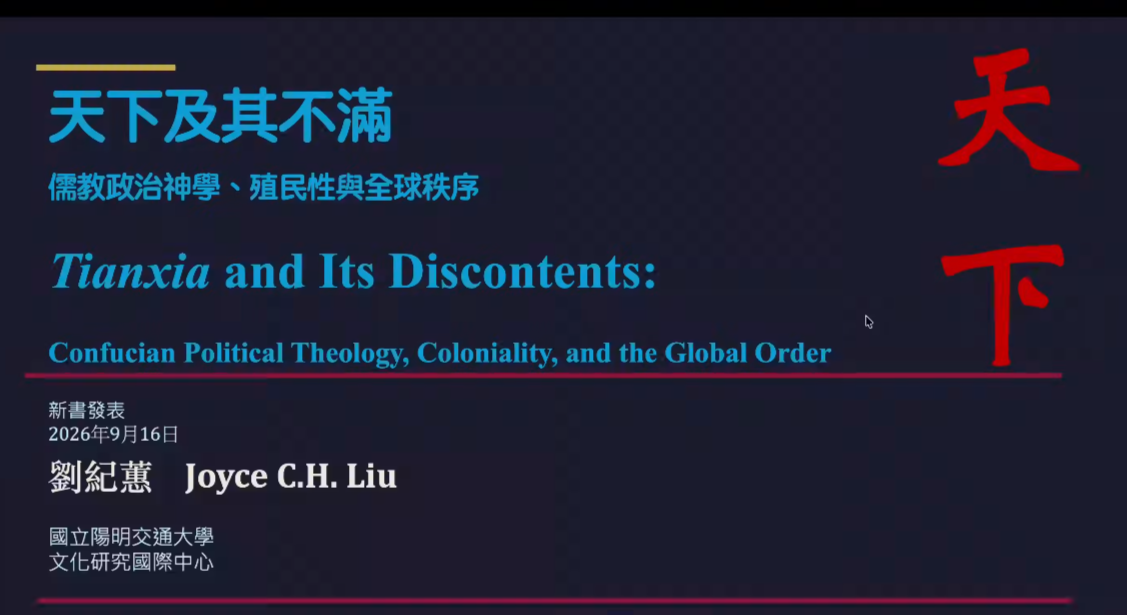
Tianxia and Its Discontents: Confucian Political Theology, Coloniality, and the Global Order (Routledge, 2026b)
2026-10-01
more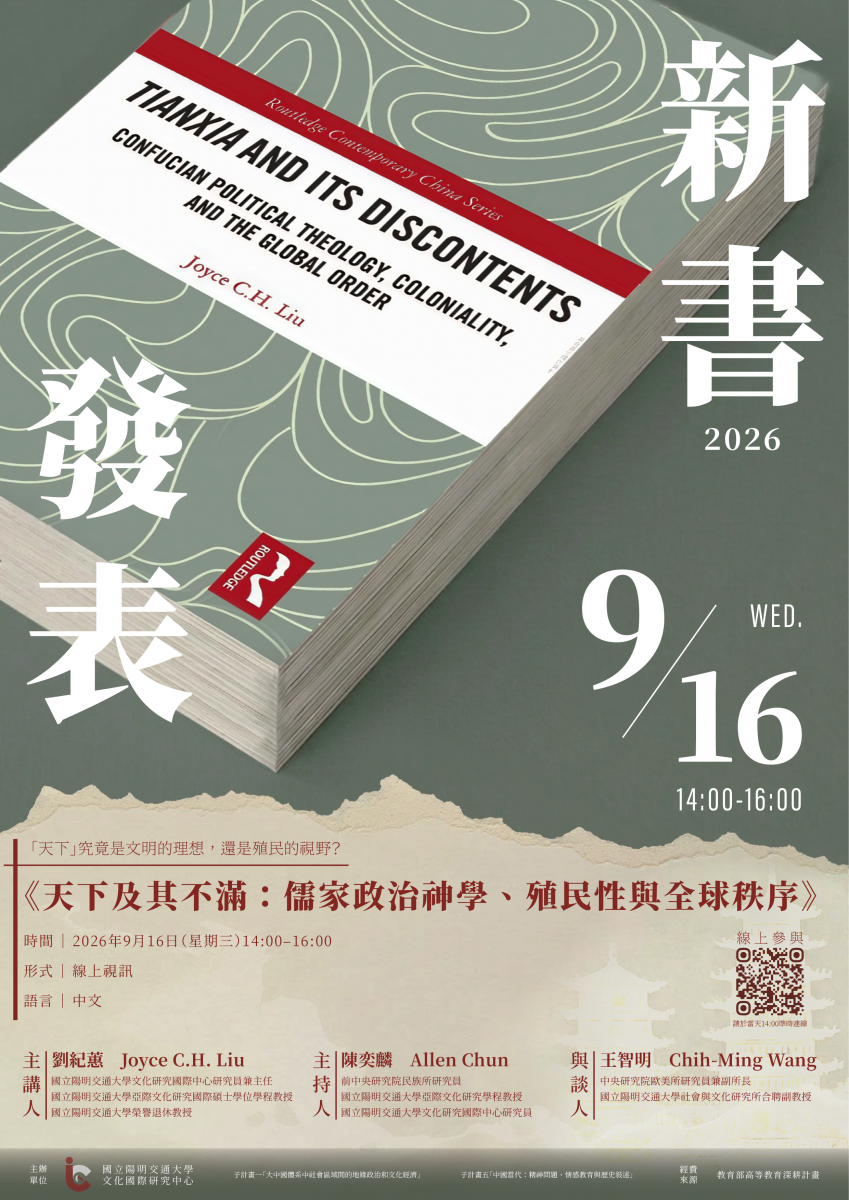
report|Tianxia and Its Discontents: Confucian Political Theology, Coloniality, and the Global Order (Routledge, 2026b)
2026-09-29
more.jpg)
.jpg)