
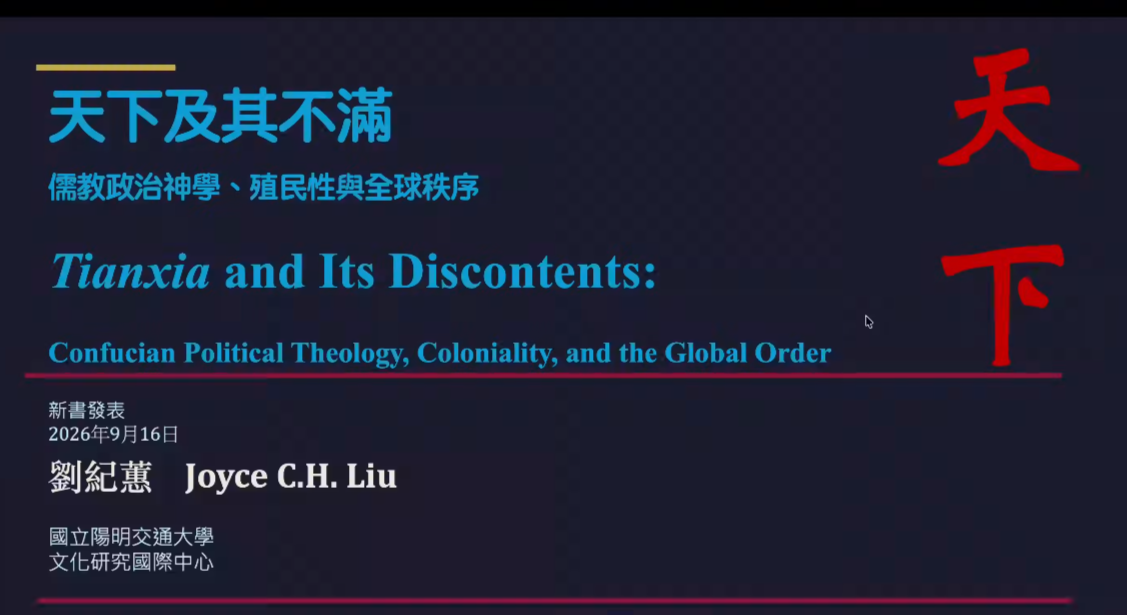
Tianxia and Its Discontents: Confucian Political Theology, Coloniality, and the Global Order (Routledge, 2026b)
2026-10-01
Tianxia and Its Discontents: Confucian Political Theology, Coloniality, and the Global Order (Routledge, 2026b)
Date: September 16, 2026, 14:00–16:00 (GMT+8 / Taiwan Time)
Format: Online
Event Page: [Link]
Event Photo: [Link]
Event Recording: [Link]
Publication Information: [Link]
Speaker: Ji-Hui Liu, Research Fellow and Director of the International Center for Cultural Studies, National Yang Ming Chiao Tung University; Professor, International Program in Inter-Asia Cultural Studies, National Yang Ming Chiao Tung University; Emeritus Professor, National Yang Ming Chiao Tung University
Moderator: Yi-Lin Chen, Research Fellow, International Center for Cultural Studies, National Yang Ming Chiao Tung University
Discussant: Chih-Ming Wang, Research Fellow and Deputy Director, Institute of European and American Studies, Academia Sinica
Affiliated Projects: Sub-Projects 1 and 5
Principal Investigators: Yi-Lin Chen and Chih-Ming Wang
Event Report by: Fanny Yu, PhD Student, Department of Anthropology, National Tsing Hua University
On September 16, 2026, the International Center for Cultural Studies (ICCS) hosted an online book launch for Ji-Hui Liu’s latest book, Tianxia and Its Discontents: Confucian Political Theology, Coloniality, and the Global Order (Routledge, 2026b), published in June 2026. The event was moderated by Yi-Lin Chen, with Chih-Ming Wang serving as discussant. The discussion not only provided an opportunity for different sub-projects at ICCS to engage with shared questions concerning contemporary realities, but also offered a space for Liu to reflect on more than two decades of intellectual development and to examine the transformation of Chinese epistemology.
Liu’s earlier research has drawn on Chinese intellectual traditions and historical contexts to trace the politics of the “mind” (xin) and the technologies of governing the mind. Her work examines how modern Chinese discourses of governing the mind retranslated and reassembled elements of political economy, Christian forms of self-cultivation, and Confucian ethics, transforming the bodies, minds, and productive capacities of the population into objects of governance (Liu, 2000; 2004; 2011; 2020; 2023).
As this line of inquiry reaches the unfinished dimensions of Confucian political theology, her new book turns its attention to tianxia (天下), asking not only how it constitutes a particular image of the world, but also how it becomes materialized through mechanisms of territorial appropriation, population classification, everyday discipline, and digital governance (Liu, 2022; 2026a; Liu, 2026c).
The book is divided into four parts, addressing, respectively, the tianxia order; the persistence of the tianxia structure within the modern nation-state; the digital tianxia of the twenty-first century; and the “cracks, remainder, and beginning” at the limits of tianxia (Liu, 2026b).

Professor Liu Begins Her Book Presentation
As a desire and vision of governance, why is the imagination of tianxia so readily mobilized? How is this imagination deployed, and how does it produce material effects? By placing it in comparative perspective with Western maritime empires, how might we re-identify the coloniality of land-based empires, as well as the spatial form of tianxia—distinct from maritime colonialism, yet likewise involving territorial appropriation and the governance of populations?
Liu first reflected on the contemporary mainstream discourse of “tianxia without an outside” (tianxia wu wai), which understands tianxia as an inclusive form of cosmopolitanism. Within tianxia, there is no absolute Other, but only positions differentiated according to degrees of distance, proximity, affinity, and estrangement. From this perspective, the epistemology of tianxia holds the potential to transcend national politics and establish a universal order that accommodates and incorporates differences (Zhao, 2005). Yet does this seemingly unconditional inclusion conceal a mechanism of “exclusion through inclusion”? Is the expansion of the “One” that constitutes tianxia achieved through techniques that civilize, submit, or assimilate those who are different?
Liu further explained the proposition that “China is not One.” What is called China is, in fact, a historical process in which multiple forces and formations of power have been juxtaposed, overlapped, and reconfigured. Beneath the appearance of a tianxia without remainder lies a systematic incorporation and elimination of various forms of remainder—deceased populations, political regimes and ethnic groups, languages, and cultures—driven by the ruler’s insatiable desire for power, or what might be understood as a maritime-like libidinal desire (Freud, 1961 [1930]).
What role, then, does Confucian political theology play in this mechanism of rendering everything “without an outside,” and in the continual elimination of the “remainder”? Reading this alongside Carl Schmitt’s The Nomos of the Earth (2003 [1950]), Liu pointed out that the European colonial order began with the appropriation, division, and production of land. The law of tianxia likewise involves the occupation of space, but assumes a different universalizing form: even before actual conquest takes place, the lands and peoples within the horizon of vision have already been incorporated into the moral universe of the Son of Heaven, awaiting the arrival of civilization to “pacify” or “civilize” them. Conquest is thus renamed, while violence is clothed in the language of benevolence and grace.
The colonial history of maritime empires is relatively easy to identify. By contrast, the history of land-based imperial expansion often disappears into narratives of dynastic succession and civilizational continuity. The cultural imagination of “the unity of Heaven and humanity” (tianren heyi), for example, gathers the human within the order of Heaven. In this sense, the theologically framed Mandate of Heaven transmitted across successive dynasties, ritualized hierarchies, Confucian ethics and bureaucratic institutions such as the imperial examination system, collective responsibility systems, the lijia and baojia systems, community compacts, the compilation of registers and gazetteers, literary inquisitions, the buying and selling of domestic servants and slaves, and frontier systems of indirect rule (jimi) all functioned as Confucian governing apparatuses—everyday technologies of power that sustained the tianxia vision of “no outside.”
Together, these practices constituted a tianxia that was cosmological, moralized, universalizing, hierarchically differentiated, disciplinary, and oriented toward the elimination of an outside—a “cruel topography,” to borrow Étienne Balibar’s formulation (Liu, 2024; Balibar, 2004).
Moreover, this Confucian apparatus of “tianxia without an outside” could be appropriated by different rulers. Han Chinese dynasties, steppe regimes, Manchu emperors, and even modern Japan’s imagination of the “universe under Heaven” (uchū) could all draw upon similar political scripts to legitimize their own positions at the center.
In the twenty-first century, the spatial imagination of tianxia has once again been reassembled under digital conditions. Algorithmic surveillance, social credit systems, Internet censorship, cross-platform data integration, and governance interfaces extended outward through the Belt and Road Initiative and digital infrastructure mean that “no outside” no longer refers only to territory, but also extends to data, bodies, and everyday behavior.
The so-called “digital tianxia” is therefore not a simple reproduction of ancient institutions, but a transformation of imperial modes of governance under new technological conditions—a transformation of the “cruel topography.” Tianxia is a mutable field of vision, while its material practices are manifested in territorial expansion.
How can one escape from an order that claims to have “no outside”? In the final section of the lecture and the book, Liu turned to the philosophy of transformation in Fang Yizhi’s Yiyu (Remainders of the Changes), suggesting that yin and yang are each other’s remainder, and that things reveal possibilities not yet completed through their encounters and transformations.
The “remainder” is therefore simultaneously the outside, the after, and the remainder of tianxia without an outside—residue, remainder, surplus, and excess. It marks the point that every established order is unable to fully incorporate, and thus the position from which critique can emerge.
This possibility of coexistence also emerges in the artistic practices of Xu Bing, Wu Tien-chang, and Chen Chieh-jen. Precisely because art can redeploy materials, memories, and forms of perception discarded by existing orders, it can open up possibilities for coexistence. In Phoenix, Xu Bing uses discarded tools, construction materials, and traces of labor to bring back into view the bodies consumed beneath the appearance of prosperity. Wu Tien-chang brings to the surface, through images, the shame, inferiority, and domestic specters internalized through colonial history. Chen Chieh-jen, meanwhile, recalls the lives of women workers, Indigenous peoples, migrant workers, and others whose lives have been threatened or abandoned by the order of global capital.
Rather than assigning a fixed identity to those who have been suppressed, these artists alter the direction of our gaze, allowing beings previously treated as waste, background, or collateral cost to re-emerge as active participants in history. Beginning from the position of the “remainder,” how, then, might we rethink the coexistence of different wills to life without allowing “coexistence” itself to be once again incorporated into the homogenizing logic of “tianxia without an outside”? (Liu, 2026a) This remains a question for continued reflection.

Professor Wang Begins His Discussion
Chih-Ming Wang began his discussion by affirming the book’s deep intellectual grounding and its ability to engage with contemporary realities in a concrete and “grounded” manner. Many of the important thinkers discussed in the book lived in specific historical contexts marked by dynastic transition and political upheaval, which, to some extent, also resonate with our own present circumstances. What kinds of reflections on contemporary reality can a critique of tianxia offer us? Beginning with the sense of threat experienced during periods of dynastic transition, to critique tianxia is also to consider what we, as intellectuals, can still do today: How might we develop cultural imagination, discursive capacities, and spaces for action?
Wang then shifted the question from the historical violence of tianxia toward the question of analytical scale. If both tianxia and empire operate through occupation, assimilation, and institutional mechanisms, what distinguishes the two? Can tianxia serve as an important perspective through which to understand empire? How should we conceptualize the differences between tianxia and empire at the level of their respective problematics?
If tianxia is a framework that can be used to analyze structures of control, can it also help us understand imperial orders formed by the United States, France, or capital, thereby avoiding reducing the issue to a form of “Chinese exceptionalism”? In other words, the significance of tianxia lies not merely in Confucian civilization, but also in the consequences produced by various forms of structural violence. Critique, therefore, should be directed toward questioning and dismantling existing colonial conditions.
Wang further noted that the history of Confucianism and tianxia cannot be understood solely in terms of their service to imperial rulers. The thought of Huang Zongxi, Gu Yanwu, and Wang Fuzhi, as well as the broader tradition of Wang Yangming’s learning, also contains intellectual resources for imagining local society, popular self-governance, and equality.
Intellectuals could enter the bureaucratic system and provide legitimacy for the existing order, but during periods of dynastic transition, they could also align themselves with local communities and articulate critiques of centralized power. An analysis of tianxia, therefore, should not reduce power to the authority of a single autocratic ruler. It must also ask how bureaucrats and intellectuals participated in the operation of institutions, and whether Confucian thought itself contained intellectual resources capable of resisting political theology.
Shifting the perspective from “outside tianxia” to “within tianxia,” and from imperial sovereignty to the articulation of national sovereignty, how might we rethink the transformation, reconfiguration, and renewed invocation of tianxia? How can we consider forms of self-preservation and self-governance within tianxia by attending to its internal limits, fissures, and contradictions?
Is Taiwan situated within tianxia, or outside it? Should the Han Chinese migration and settlement of Taiwan be understood as an extension of tianxia, or as a form of resistance to it? Is Taiwan an unfinished constitutive element of tianxia, or a “remainder” that exposes its limits?
As a site where multiple historical trajectories—the Ming loyalist regime, Japanese colonial rule, the Republic of China, and the U.S.-led Cold War order—intersect and overlap, Taiwan can neither be simply described as a position outside any particular empire, nor reduced to a frontier within competition among great powers. What matters, therefore, may not only be the coloniality of tianxia in its outward expansion, but also the coloniality involved in its internal pressure and extension.
Starting from Taiwan as the limit of tianxia, how might a critique of what lies both within and beyond tianxia articulate a value of justice and become an intellectual resource capable of illuminating the next historical moment? And if tian

劉紀蕙老師給予回應
Liu responded that she is indeed particularly interested in thinkers who lived through periods of dynastic transition, and that her critical position also emerges from within. Throughout the history of Chinese thought—from Zhuangzi and Huang Zongxi to Tan Sitong, Zhang Taiyan, and Fang Yizhi—there has been a persistent and powerful tradition of internal critique.
She further clarified that her critique of tianxia distinguishes among the tianxia of the ruler, the tianxia of thinkers, and tianxia as an apparatus of governance. What she critiques is not every thinker who has employed the vocabulary of tianxia, but rather the system that deploys Confucian political philosophy and political theology as strategies of rule. It is precisely this material apparatus that sustains the ruler’s imperial ambitions of expansion—the “discontents” of tianxia.
The question, therefore, is not one of placing everyone back into the single category of “Confucianism,” but of identifying how different forms of thought become aligned with power at particular historical moments, and how they may, in turn, open up a critical distance within the fissures and limits of an established order. Only by attending to these differences, Liu suggested, might we become capable of listening to the Other and opening possibilities for coexistence.
At the same time, Liu emphasized that tianxia must not simply be reduced to “empire” as a way of avoiding or legitimizing the distinctive forms of violence embedded
within our respective historical circumstances, we need to understand the histories, cultures, and affects that shape them, and pursue an inquiry into how violence can be prevented from being reproduced.

Questions from the Audience
During the Q&A session, Professor Hsiu-Ping Tseng raised a question concerning the continuity between the notion of tianxia as family (jia tianxia) and modern conceptions of the nation-state. Even when people today may not fully grasp the historical context of the tianxia concept, classical notions of unification and a Central Plains-centered worldview may still be reactivated and deployed to construct the boundaries and identities of the modern state.
Liu responded that jia tianxia contains a logic of ownership: tianxia is understood as something possessed by “me” or “my family.” Her inquiry, she emphasized, is not limited to the People’s Republic of China after 1949. Rather, it examines how different modern and contemporary political regimes have repeatedly drawn upon cultural orthodoxy, the nation-state, and the imagination of tianxia to legitimize their positions of rule.

Professor Yi-Lin Chen then brought the discussion to the recent “tianxia turn” in Western academia: Why has tianxia come to be regarded as an alternative to the Western international order (Wang, 2017)?
Liu pointed out that terms such as “mutual benefit,” “shared prosperity,” and “world community” must be examined in relation to their concrete material conditions. When the transnational expansion of infrastructure, mineral resources, and digital networks is accompanied by resource extraction and labor exploitation, an order that appears to transcend imperial competition may nevertheless reproduce colonial relations. A critique of tianxia, therefore, cannot remain at the level of comparing civilizational ideals. It must instead trace where capital, technology, and governing apparatuses actually arrive, and what forms of inequality they enable to persist.
Toward the end of the discussion, Wang further raised the question of intellectuals and the meaning of “yielding” (rang). If tianxia, as an analytical framework, still presupposes a ruler who occupies and controls space, with the possibility of “yielding” depending on that ruler’s willingness to make concessions, should we instead seek, from within the system, an institutional order without a sovereign ruler? In other words, how should we rethink the position and role of intellectuals within the tianxia order?
Liu explained that “yielding” does not mean asking a ruler to relinquish power. Rather, each person must leave room for others to maneuver and find their own paths of existence. Every form of life has its own “will to life,” but when one will to life continually expands until it occupies everything, other forms of life lose the space they need to exist. To make room for the “remainder,” therefore, is not an act of passive retreat, but a transformation in our modes of thinking and seeing.
This also means that “coexistence” should no longer be imagined as a harmonious scene without conflict. Genuine coexistence may begin precisely where the commands of an overarching order cease to function: on the shifting terrain where boundaries move, relationships intersect, and lives cannot be fully incorporated, people continuously recalibrate their positions in relation to one another. The fissures within tianxia are not defects that must necessarily be repaired; they are the conditions through which other histories, other forms of life, and other relationships can emerge.
The book discussion did not seek to provide a closed definition of tianxia. Instead, it continually unfolded the tensions within the term itself. Tianxia can be a vision of comprehensive possession exercised by a ruler, but it can also be a language through which literati admonish power. It can function as a political theology of imperial expansion, while also containing resources for local communities and thinkers to develop internal critiques of established orders. The question, therefore, is to identify who claims to speak for tianxia, through what apparatuses, at whose expense, and which voices are excluded from the visible world.
At the conclusion of the event, Liu described her own work as an unfinished project. She hopes to continue tracing how poets, artists, and people from different communities have recorded their own circumstances across different historical periods, thereby opening up an “alternative history of China” constituted through lived experiences.
The possibilities available to intellectuals may be limited, yet they can still identify the warning signs of danger when the potential for expansion and development begins to take shape. They can also refuse to regard the sacrifices produced by dynastic transition, civilizational progress, or great-power competition as inevitable.
If the power of tianxia lies in bringing everything into an order without an outside, then the power of the “remainder” lies in reminding us that the world has never been completely possessed by any single center. To open other histories through discontent is not simply to add chapters for those who have been forgotten. It is also to relearn how to look, how to listen, and how to leave, beyond our own will to life, a space in which others may still begin.
趙汀陽。2005。《天下體系:世界制度哲學導論》。江蘇教育出版社。
劉紀蕙。2000。《孤兒・女神・負面書寫:文化符號的徵狀式閱讀》。台北:立緒文化。
———。2004。《心的變異:現代性的精神形式》。台北:麥田出版。
———。2011。《心之拓撲:1895事件後的倫理重構》。台北:行人文化實驗室。
———。2020。《一分為二:現代中國政治思想的哲學考掘學》。新北:聯經出版。
———。2022。〈從「一分為二」出發,重新思考中國古典思想中的共生思維:再論方以智的一分為二於唯物辯證〉,《「漢學之島」與「共生哲學」:跨文化國際研討會》,國立中山大學,2022年7月7日至7月9日。
———。2023。《心態史拓撲學:如何面對當代?如何理解歷史?》。台北:時報文化出版企業股份有限公司。
———。2024。〈佛洛伊德、巴禮巴於「文明性」的悖論:政治拓撲學的難題〉,《文化研究》38: 11–14。
———。2026a。〈天下共生的悖論:何謂「天下」?天下之「餘」在何處?〉,《文化研究》42: 9–54。
Balibar, Étienne. 2004. “Outline of a Topography of Cruelty: Citizenship and Civility in the Era of Global Violence.” In We, the People of Europe?, 115–132. Princeton University Press.
Freud, Sigmund. 1961 [1930]. “Civilization and Its Discontents.” In The Standard Edition of the Complete Psychological Works of Sigmund Freud, vol. 21, translated by James Strachey, 57–145. Hogarth Press.
Liu, Joyce C. H. 2026b. Tianxia and Its Discontents: Confucian Political Theology, Coloniality, and the Global Order. Routledge.
———. 2026c. “South of the South, the Kaohsiung Port City of Taiwan.” In R. Samaddar, A. Morlicchio, & S. Mezzadra (Eds.), The City as the Southern Question: Alternative Histories of Urbanisation After Gramsci, 265–283. Routledge.
Schmitt, Carl. 2003 [1950]. The Nomos of the Earth in the International Law of the Jus Publicum Europaeum. Translated and annotated by G. L. Ulmen. Telos Press.
Wang, Ban, ed. 2017. Chinese Visions of World Order: Tianxia, Culture, and World Politics. Duke University Press.
近期新聞 Recent News
Tianxia and Its Discontents: Confucian Political Theology, Coloniality, and the Global Order (Routledge, 2026b)
2026-10-01
more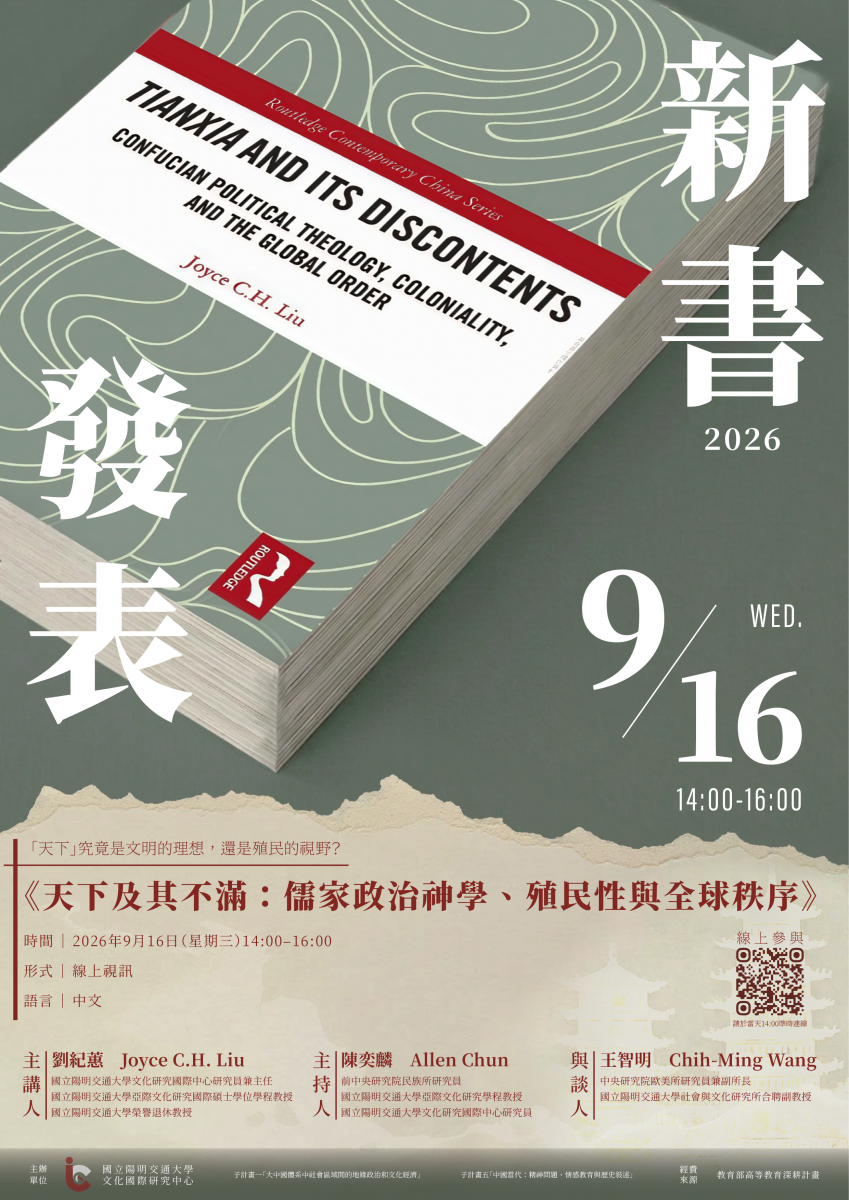
report|Tianxia and Its Discontents: Confucian Political Theology, Coloniality, and the Global Order (Routledge, 2026b)
2026-09-29
more.jpg)
.jpg)