近期出版 Recent Publication
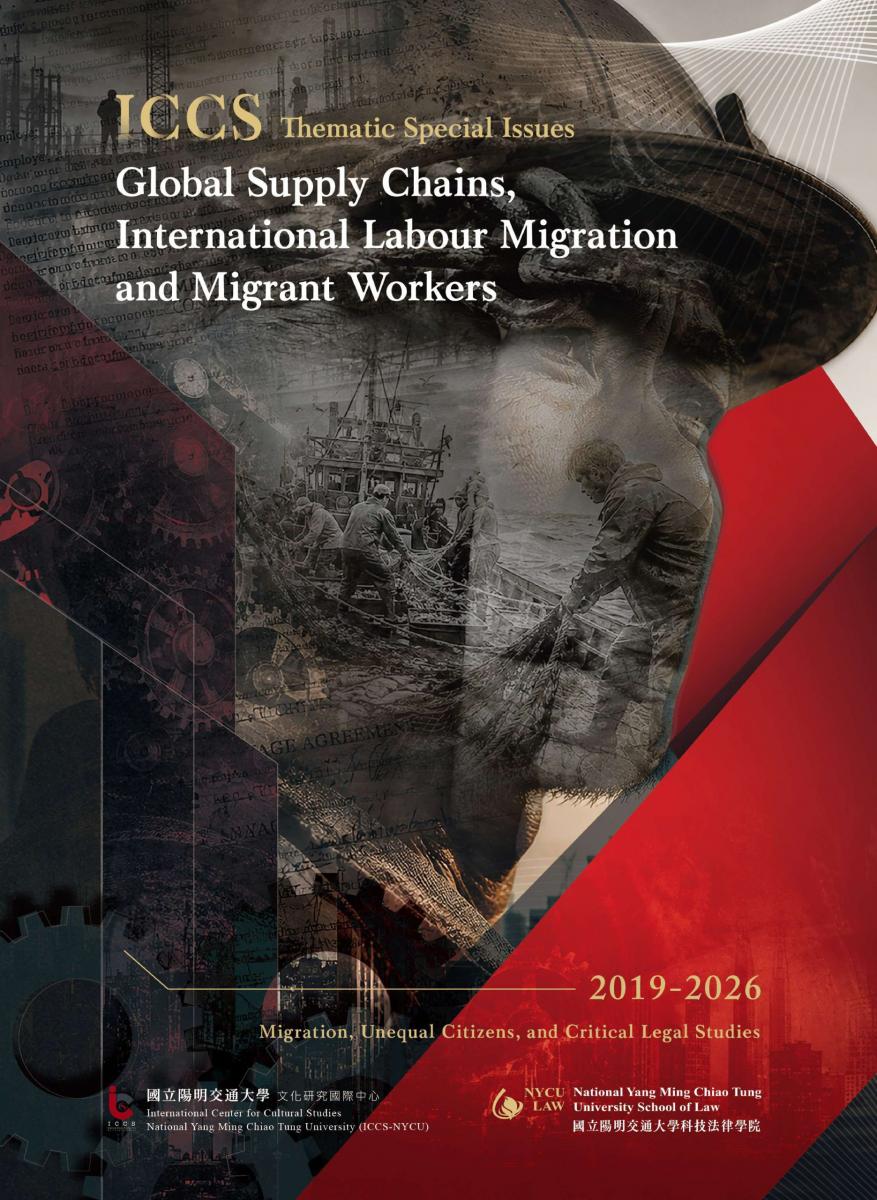
ICCS Thematic Special Issues: Global Supply Chains, International Labour Migration and Migrant Workers (2019–2026) — Migration, Unequal Citizens, and Critical Legal Studies
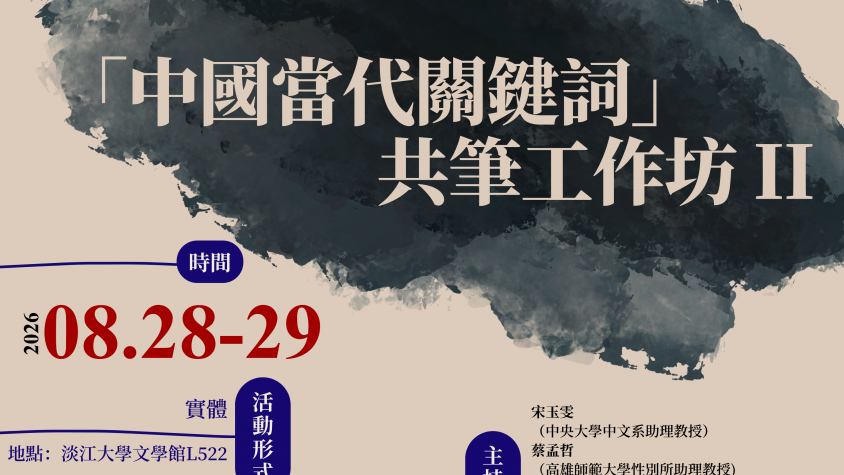
more“Contemporary China Keywords” Collaborative Writing Workshop II-4.Self-Organization
2026-10-19
Date: August 28–29, 2026
Venue: Room L522, Literature Building, Tamkang University
Format: In-person
Organizers: Contemporary China Research Project, International Center for Cultural Studies (ICCS), National Yang Ming Chiao Tung University; Department of Chinese, Tamkang University
Abstract
The “Contemporary China Keywords” Collaborative Writing Workshop seeks to use “keywords” as a methodological approach to understanding contemporary China. Rather than simply collecting popular expressions or cultural phenomena, the workshop focuses on the two mutually constitutive concepts of “China” and “the contemporary.” Through a series of keywords, it seeks to map the historical experiences, institutional characteristics, affective structures, and cultural imaginaries of contemporary China.
Temporally, we take 1949 and the period from 1978 to 2000 as two important historical starting points for understanding “contemporary China.” We also treat “China” itself as a concept that requires renewed scrutiny. Our objective extends beyond examining the meanings of individual words. Instead, we approach each keyword as an entry point into the historical, literary, social, and intellectual contexts through which contemporary China can be understood.
Through collaborative writing and collective discussion, we hope to gradually develop a shared conceptual vocabulary for understanding contemporary China, map its complex landscape, and establish a body of literature and research resources that can serve as a reference for future scholarship.
Song Yuwen, Assistant Professor, Department of Chinese, National Central University
Tsai Meng-Che, Assistant Professor, Graduate Institute of Gender Studies, National Kaohsiung Normal University
Huang Wen-Chien, Associate Professor, Department of Chinese, Tamkang University
Wang Chih-Ming, Research Fellow, Institute of European and American Studies, Academia Sinica; Convener of the Contemporary China Subproject
Luo Xiaoming, Associate Professor and Chair, Department of Humanities, Shanghai University
Author: Liu Cunquan, Master’s Student, Department of Geography, National Taiwan University
I was delighted to participate in the Chinese Contemporary Keywords Collaborative Writing Workshop. The keyword I submitted was “Self-Organization.” My interest in this phenomenon stems from my own experiences and concerns. I have previously been involved in organizing in Kuala Lumpur, and through conversations with many travelers, I learned about self-organized communities in Guangzhou, China. I have also read their self-published materials, and I have long been curious about how these communities organize themselves. Therefore, when I was asked to submit a key phenomenon related to contemporary China, the people involved in self-organized communities naturally came to mind.
Guangzhou was once home to numerous self-organized communities that explored forms of collective life beyond mainstream society through alternative spaces, independent publishing, and everyday social interactions. Although some of these organizations have ceased operating, the zines, charters, and interview articles they left behind allow me to look back at how these communities formed and operated, what activities they organized, what challenges they faced, and how they understood their own practices. Reading these materials, I identified three key characteristics shared by these communities: collective governance, non-subjectivity, and everyday interaction. Collective governance refers to their attempts to counter individualism and social atomization through collective responsibility and shared decision-making. Non-subjectivity means that a collective does not necessarily have to be built around a unified set of goals or a single shared vision. Instead, individual members describe the collective and present its character to the outside world in their own ways. At the same time, these communities placed particular emphasis on everyday interactions, believing that friendship, trust, and a sense of community often gradually develop through ordinary activities such as sharing meals and chatting.
In light of discussions at other sessions of the workshop about the mental and emotional states of young people in China, including involution, lying flat, and defensiveness, these self-organized communities seem to raise a question: beyond these inward-turning responses, can young people explore other possibilities for living and practicing alternative ways of life? Such public practices also reveal a transregional dimension, as self-organized art communities in Guangzhou were influenced by developments in Hong Kong and Tokyo. These spaces and publications, though now gone, preserve more than a record of alternative culture. They document the efforts of a group of people who, despite limited resources and constraints, continued to explore how to live together.
During the discussion, Professor Tsai Meng-che reminded us to consider the question of mobility within self-organized communities. Professor Luo Xiaoming emphasized that the historical connections between anarchism and art communities should not be overlooked. In a conversation after the workshop, Professor Wang Chih-ming suggested that we should further investigate what “organization” means within the historical context of China. On the one hand, under China's distinctive danwei (work-unit) system, “organization” meant that individuals entered an established institutional structure and became part of its official staffing system, often securing the equivalent of a secure, lifelong job. On the other hand, in the Chinese context, “organization” also refers to the ways in which the state and the Party mobilize the masses through social elites as a means of social governance. How, then, should we understand self-organization in relation to these two dimensions of organization?
近期新聞 Recent News