近期出版 Recent Publication
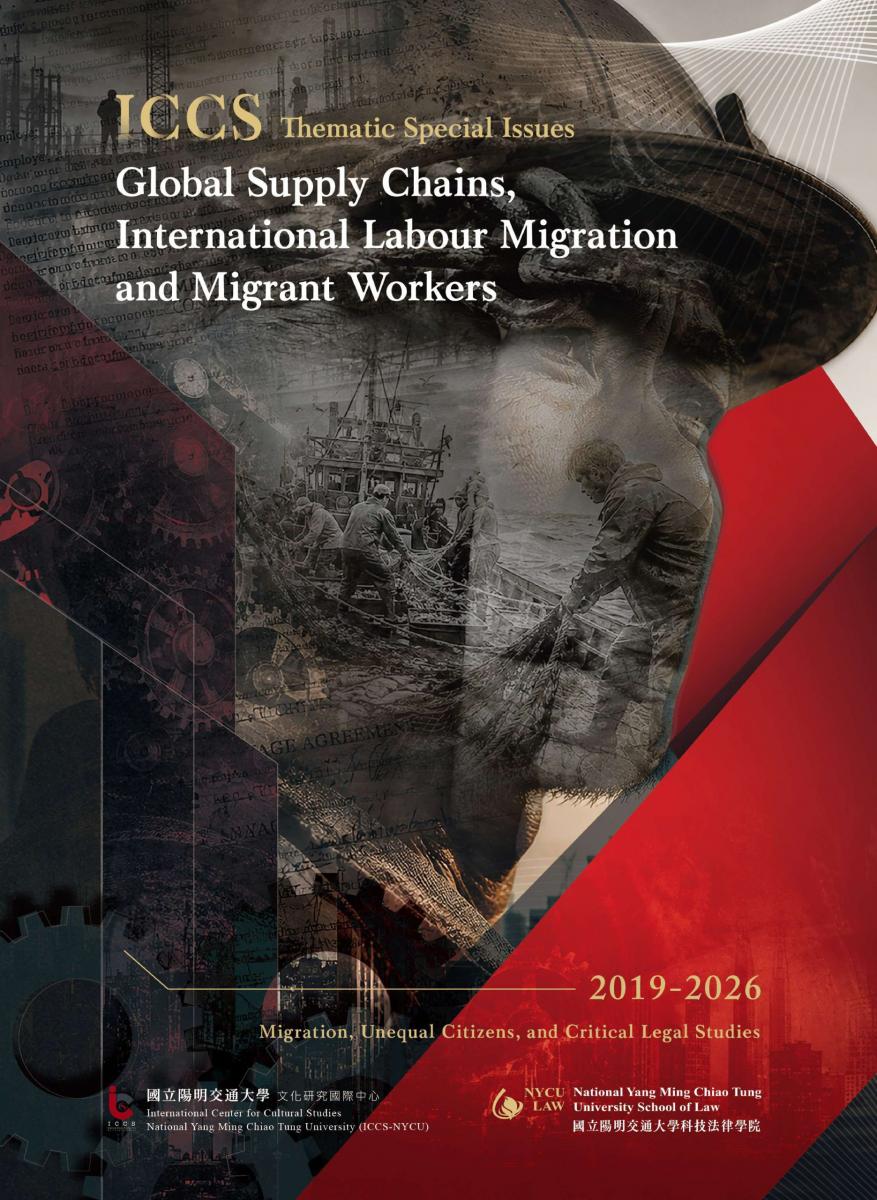
ICCS Thematic Special Issues: Global Supply Chains, International Labour Migration and Migrant Workers (2019–2026) — Migration, Unequal Citizens, and Critical Legal Studies
more“Contemporary China Keywords” Collaborative Writing Workshop II-7.Petty Bourgeoisie
2026-10-22
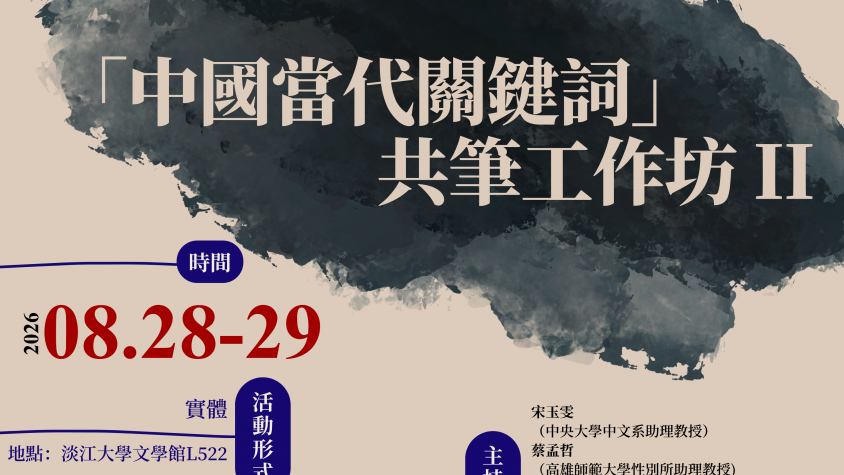
“Contemporary China Keywords” Collaborative Writing Workshop II
Date: August 28–29, 2026
Venue: Room L522, Literature Building, Tamkang University
Format: In-person
Organizers: Contemporary China Research Project, International Center for Cultural Studies (ICCS), National Yang Ming Chiao Tung University; Department of Chinese, Tamkang University
Abstract
The “Contemporary China Keywords” Collaborative Writing Workshop seeks to use “keywords” as a methodological approach to understanding contemporary China. Rather than simply collecting popular expressions or cultural phenomena, the workshop focuses on the two mutually constitutive concepts of “China” and “the contemporary.” Through a series of keywords, it seeks to map the historical experiences, institutional characteristics, affective structures, and cultural imaginaries of contemporary China.
Temporally, we take 1949 and the period from 1978 to 2000 as two important historical starting points for understanding “contemporary China.” We also treat “China” itself as a concept that requires renewed scrutiny. Our objective extends beyond examining the meanings of individual words. Instead, we approach each keyword as an entry point into the historical, literary, social, and intellectual contexts through which contemporary China can be understood.
Through collaborative writing and collective discussion, we hope to gradually develop a shared conceptual vocabulary for understanding contemporary China, map its complex landscape, and establish a body of literature and research resources that can serve as a reference for future scholarship.
Moderators
Song Yuwen, Assistant Professor, Department of Chinese, National Central University
Tsai Meng-Che, Assistant Professor, Graduate Institute of Gender Studies, National Kaohsiung Normal University
Huang Wen-Chien, Associate Professor, Department of Chinese, Tamkang University
Wang Chih-Ming, Research Fellow, Institute of European and American Studies, Academia Sinica; Convener of the Contemporary China Subproject
Keynote Speaker
Luo Xiaoming, Associate Professor and Chair, Department of Humanities, Shanghai University
Author: Zhu Ye, Lecturer, Department of Cultural Studies, Shanghai University
The term “petty bourgeois” evolved from “petty bourgeoisie.” Discussing the “petty bourgeois,” therefore, is in effect an examination of the paired keywords “petty bourgeois” and “petty bourgeoisie.” Why have these terms become keywords for understanding contemporary China? Zhu Ye referred to the criteria for selecting keywords that Professor Wang Chih-ming had outlined when convening this workshop: a keyword should not only prompt us to reflect on the question “What is China?” but also help us understand the multiple starting points of “the contemporary,” particularly those marked by 1949 and 1978. Zhu argued that “petty bourgeois” and “petty bourgeoisie” fulfill both of these requirements.
Regarding the question “What is China?,” although “petty bourgeoisie” is a term imported from the West, its historical influence on Chinese society has been far more profound than in Western societies. In Marx’s analysis of British society, the petty bourgeoisie was merely a transitional class destined to be absorbed in the process of industrialization. In his analysis of the French Second Republic, the petty bourgeoisie, consisting primarily of smallholding peasants, was a politically unstable force that vacillated during the revolution. In the context of the Chinese Revolution, however, the concept acquired an entirely different meaning: it became almost synonymous with “intellectuals,” giving rise to an entire set of discursive practices centered on the “remolding of intellectuals.” The historical logic behind this difference lies in the fact that Chinese society at the time faced problems fundamentally different from those confronting British and French societies. This difference was also related to the distinctive historical role played by intellectuals in the Chinese Revolution. The term thus reflects the particular social and historical characteristics of the twentieth-century Chinese Revolution, which set it apart from Western revolutionary experiences.
Regarding the question of “the contemporary,” Zhu traced two major shifts in the meaning of these terms in China, arguing that they reflect historical transformations in Chinese society. The first shift occurred around 1978. Before this point, “petty bourgeoisie” continued the tradition of critical discourse established by the Yan’an Talks on Literature and Art, functioning as a political label for a class that needed to be remolded and overcome. After 1978, as the focus of social development shifted from revolutionary politics to depoliticized economic development, the term gradually lost its class-critical connotations. It evolved instead into a shorthand for a lifestyle associated with cultural consumption and aspired to by the urban middle class. The term itself was also shortened from “petty bourgeoisie” to “petty bourgeois.”
The second shift occurred in the mid-2010s. Although the lifestyle associated with being “petty bourgeois” had not fundamentally changed, the positive aspirations it embodied were increasingly replaced by an inexpressible sense of resignation and self-mockery. New expressions such as “refined poverty” and “pseudo-petty bourgeois” emerged in succession. The broader context for this shift was China’s transition from rapid economic growth to a slower pace of expansion, accompanied by declining expectations of upward class mobility. As a result, the lifestyle ideals of the urban middle class began to lose their appeal.
Zhu concluded by highlighting the methodological significance of these paired terms. Discussions of the “petty bourgeois” reveal that the relationship between keywords and social reality is not one of simple reflection. Words themselves function as discursive practices and mechanisms for producing reality: they participate in shaping subjectivities and, in turn, social formations. Whether through the discourse of the “petty bourgeoisie” during the revolutionary era, which disciplined and interpellated intellectual subjects, or through the discourse of the “petty bourgeois” after the reform and opening-up, which shaped subjects oriented toward cultural consumption, both examples demonstrate that language is not merely a mirror reflecting reality; it is also a force that produces it.
近期新聞 Recent News