近期出版 Recent Publication
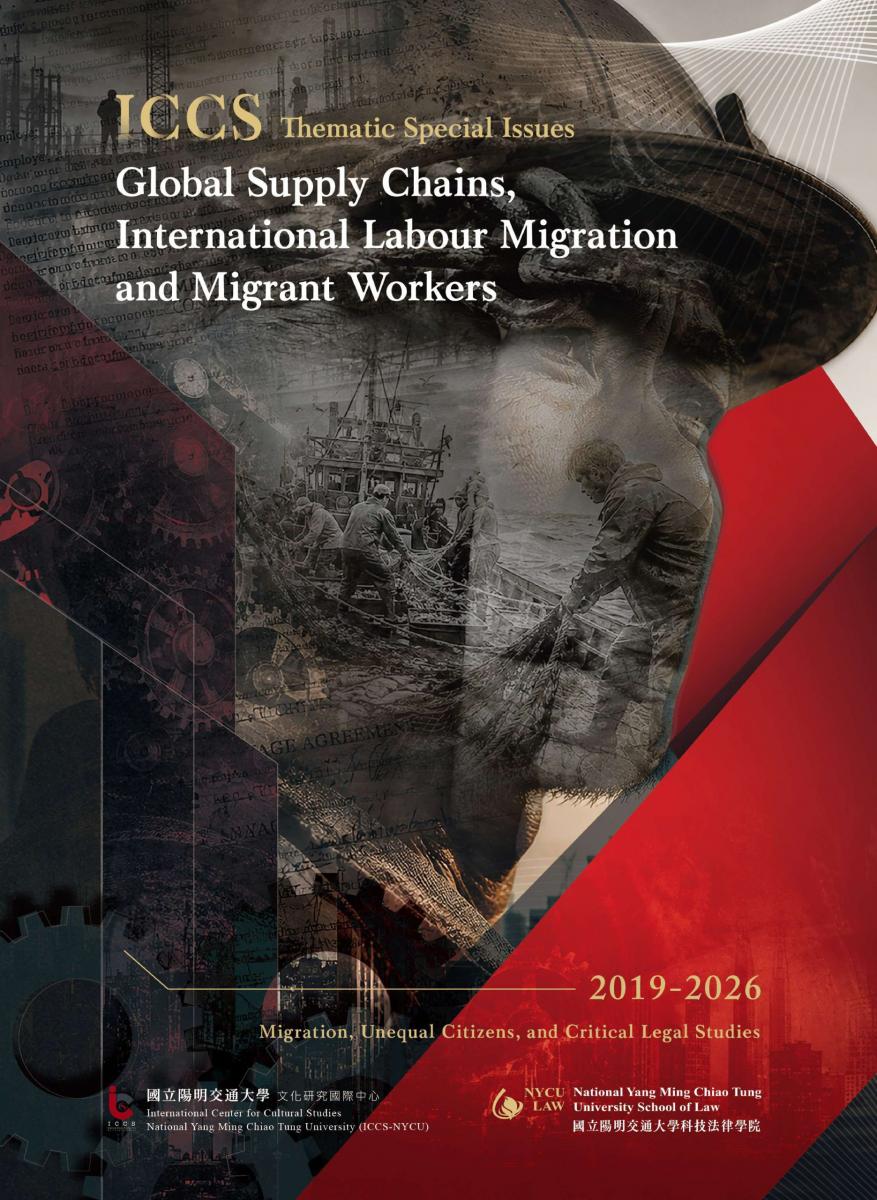
ICCS Thematic Special Issues: Global Supply Chains, International Labour Migration and Migrant Workers (2019–2026) — Migration, Unequal Citizens, and Critical Legal Studies
more側記 | 「中國當代關鍵詞」共筆工作坊II - 5.災害
2026-10-20
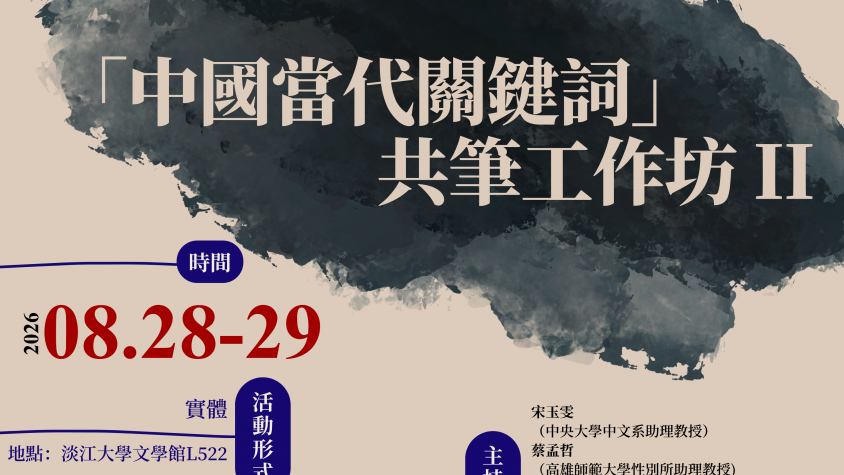
Date: August 28–29, 2026
Venue: Room L522, Literature Building, Tamkang University
Format: In-person
Organizers: Contemporary China Research Project, International Center for Cultural Studies (ICCS), National Yang Ming Chiao Tung University; Department of Chinese, Tamkang University
Abstract
The “Contemporary China Keywords” Collaborative Writing Workshop seeks to use “keywords” as a methodological approach to understanding contemporary China. Rather than simply collecting popular expressions or cultural phenomena, the workshop focuses on the two mutually constitutive concepts of “China” and “the contemporary.” Through a series of keywords, it seeks to map the historical experiences, institutional characteristics, affective structures, and cultural imaginaries of contemporary China.
Temporally, we take 1949 and the period from 1978 to 2000 as two important historical starting points for understanding “contemporary China.” We also treat “China” itself as a concept that requires renewed scrutiny. Our objective extends beyond examining the meanings of individual words. Instead, we approach each keyword as an entry point into the historical, literary, social, and intellectual contexts through which contemporary China can be understood.
Through collaborative writing and collective discussion, we hope to gradually develop a shared conceptual vocabulary for understanding contemporary China, map its complex landscape, and establish a body of literature and research resources that can serve as a reference for future scholarship.
Song Yuwen, Assistant Professor, Department of Chinese, National Central University
Tsai Meng-Che, Assistant Professor, Graduate Institute of Gender Studies, National Kaohsiung Normal University
Huang Wen-Chien, Associate Professor, Department of Chinese, Tamkang University
Wang Chih-Ming, Research Fellow, Institute of European and American Studies, Academia Sinica; Convener of the Contemporary China Subproject
Luo Xiaoming, Associate Professor and Chair, Department of Humanities, Shanghai University
It was a great honor to participate in the “Contemporary Chinese Keywords II” workshop at Tamkang University and to present alongside three senior colleagues, Chuncong, Gongzhai, and Jiang Jun, under the theme of “the Two Sides of the Taiwan Strait and Hong Kong.” I am particularly grateful to Professor Xiaoming for her insightful comments on my presentation. Professor Luo’s question also touches on something I am curious about: what role do disaster cases in Hong Kong play within the context of contemporary China? When conducting parallel comparisons, what exactly do disasters in Hong Kong have in common with recent major disasters in mainland China, such as the fire in Yinchuan, Ningxia, or the coal mine fire in Shanxi?
In fact, this question has also led me to reconsider how disaster narratives should be defined. When examining disasters, it does seem necessary to narrow the research focus and perhaps even define the central concern in terms of disasters caused by “human negligence” and “institutional failure,” rather than natural disasters in the broad sense. Overemphasizing natural disasters in the broad sense can divert attention from the focus of the social sciences and even blur the original focus on accountability. I believe that the structural issues revealed by disasters, such as power imbalances and social inequality, are what deserve greater attention.
This presentation also prompted me to consider another, more far-reaching question: in contemporary society, human technological development and civilization should have reached a considerable level of advancement, so why are disasters still so severe in scale when they occur? I believe this can largely be attributed to the logic of how capitalism operates. Under relentless cost-cutting, our lives are forced into a state of precarity.
As early as 2016, when I was still an undergraduate, a major fire broke out at the Amoycan Industrial Centre mini-storage facility in Hong Kong, claiming the lives of two firefighters. It was only after the subsequent investigation that it was revealed that Hong Kong had no legal regulations governing mini-storage facilities, exposing serious oversights in the government’s administration. Yet today, it has become even more difficult to voice calls for improvement from the grassroots. Does this mean that power itself has become more difficult to change and criticize than before?
Furthermore, what warning does this fire hold for Taiwan? Many old buildings in Taiwan still use flammable composite materials. In the early morning of September 20, a serious fire broke out at a motorcycle shop in the West Central District of Tainan City. The entire three-story building was quickly reduced to a charred skeleton by the flames. Fortunately, there were no casualties. Preliminary investigations suggest that the fire may have been related to a lithium battery explosion. I also believe that disasters are not isolated problems confined to individual cities. As our cities become increasingly dense and living spaces continue to shrink, this is something we will all have to face together in the future. What, then, can help us reduce risks and minimize the harm caused by disasters? These are some of my thoughts.
近期新聞 Recent News