近期出版 Recent Publication
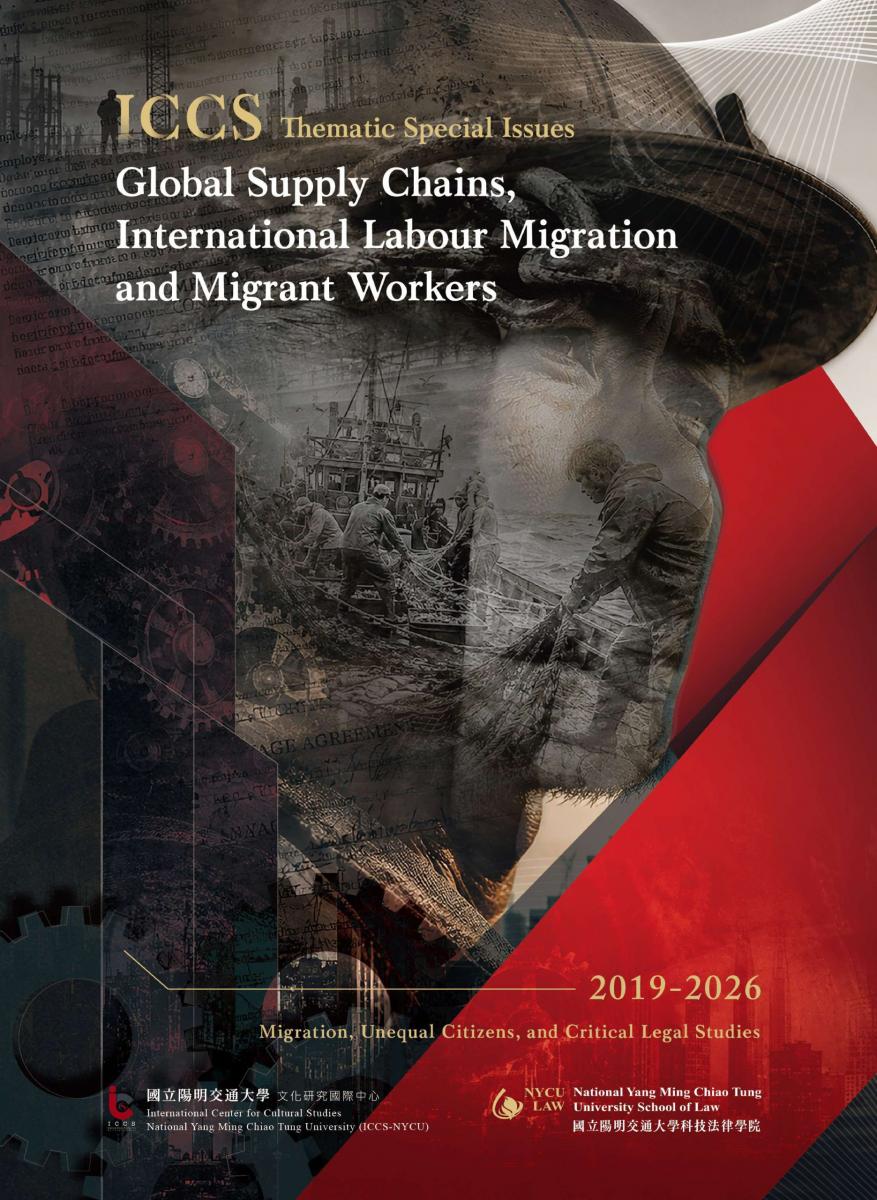
ICCS Thematic Special Issues: Global Supply Chains, International Labour Migration and Migrant Workers (2019–2026) — Migration, Unequal Citizens, and Critical Legal Studies
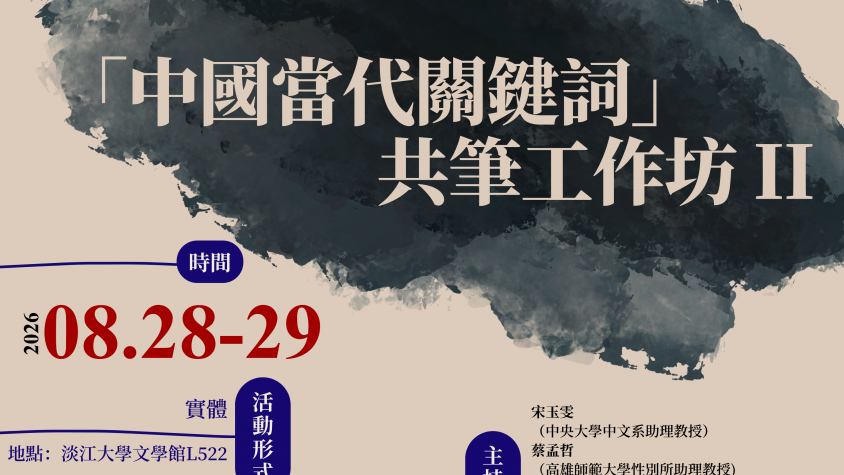
more“Contemporary China Keywords” Collaborative Writing Workshop II-6.Defense
2026-10-21
Date: August 28–29, 2026
Venue: Room L522, Literature Building, Tamkang University
Format: In-person
Organizers: Contemporary China Research Project, International Center for Cultural Studies (ICCS), National Yang Ming Chiao Tung University; Department of Chinese, Tamkang University
Abstract
The “Contemporary China Keywords” Collaborative Writing Workshop seeks to use “keywords” as a methodological approach to understanding contemporary China. Rather than simply collecting popular expressions or cultural phenomena, the workshop focuses on the two mutually constitutive concepts of “China” and “the contemporary.” Through a series of keywords, it seeks to map the historical experiences, institutional characteristics, affective structures, and cultural imaginaries of contemporary China.
Temporally, we take 1949 and the period from 1978 to 2000 as two important historical starting points for understanding “contemporary China.” We also treat “China” itself as a concept that requires renewed scrutiny. Our objective extends beyond examining the meanings of individual words. Instead, we approach each keyword as an entry point into the historical, literary, social, and intellectual contexts through which contemporary China can be understood.
Through collaborative writing and collective discussion, we hope to gradually develop a shared conceptual vocabulary for understanding contemporary China, map its complex landscape, and establish a body of literature and research resources that can serve as a reference for future scholarship.
Song Yuwen, Assistant Professor, Department of Chinese, National Central University
Tsai Meng-Che, Assistant Professor, Graduate Institute of Gender Studies, National Kaohsiung Normal University
Huang Wen-Chien, Associate Professor, Department of Chinese, Tamkang University
Wang Chih-Ming, Research Fellow, Institute of European and American Studies, Academia Sinica; Convener of the Contemporary China Subproject
Luo Xiaoming, Associate Professor and Chair, Department of Humanities, Shanghai University
Wang Xinran, Lecturer at Xuzhou University of Technology
The keyword I submitted for the Contemporary Chinese Keywords Collaborative Writing Workshop was “defense.” This keyword seeks to describe the self-protective consciousness and corresponding behavioral tendencies exhibited by subjects shaped by the process of individualization in China since the reform and opening-up. These subjects have pursued autonomy and self-responsibility, but their expectations of a developmentalist future have since undergone a shift.
Many different life choices can be reclassified and examined through this lens, among which two types of social phenomena are particularly representative.
The first is the renewed preference for employment in the state sector among young people in mainland China. Amid highly uncertain employment conditions, civil service positions have once again become exceptionally attractive in contemporary history. “Stability” has been revalued as a scarce resource that can only be obtained through intense competition. The intense competition for civil service positions reflects a defensive logic of action: when individuals bear almost all the risks associated with an uncertain future, they must strive to secure a stable position to protect themselves and prevent downward social mobility. A similar logic is also evident in changing patterns of consumption and wealth management. In recent years, saving and rational consumption have attracted increasing attention. Saving, in particular, can be understood as a concrete manifestation of a broader social sentiment in material life.
The second phenomenon concerns the drawing of boundaries in the realm of personal relationships. In recent years, people have become increasingly adept at using psychological terminology to reinterpret their own feelings and define the behavior of others, as seen in narratives about one's family of origin. Within these narratives, the importance of subjective feelings continues to grow, and such feelings have become a central framework for interpreting personal relationships. As a result, the boundaries of the self have contracted, giving rise to temporary, functional interpersonal relationships, such as the dazi culture of finding activity partners for specific purposes. Individuals need intimacy, companionship, and social connection, yet they also wish to avoid the risks of emotional exhaustion, burdens of responsibility, and the loss of autonomy that relationships may entail. Consequently, they are paying increasing attention to managing the degree of their investment in relationships and maintaining their personal boundaries. This particular demand for boundaries and functionality can be understood in the context of China's ongoing process of individualization. Once individual autonomy gains widespread legitimacy without the simultaneous development of adequate social conditions to sustain it, autonomy tends to be understood primarily as a matter of individual self-protection and self-management. Social problems are thus translated into private concerns.
Although the pursuit of stability and the reestablishment of boundaries occur in different spheres of life, both reflect a tendency to actively manage risk and personal investment. For individuals who must bear the consequences of their own lives, defense is entirely rational under existing conditions. The question, however, is how to prevent defense from becoming a mechanism for adapting to the prevailing logic of reality as it gradually becomes a dominant principle of everyday life. Rather than offering only limited protection for individual interests and private spaces, can defense instead be transformed into an active exploration and reestablishment of the principles of collective life under new circumstances? In fact, only through the latter process can autonomy truly acquire substance and vitality, thereby providing more reliable support for individuals exposed to risk.
近期新聞 Recent News