About Ranabir Samaddar: Life, Work, and Intellectual Contributions
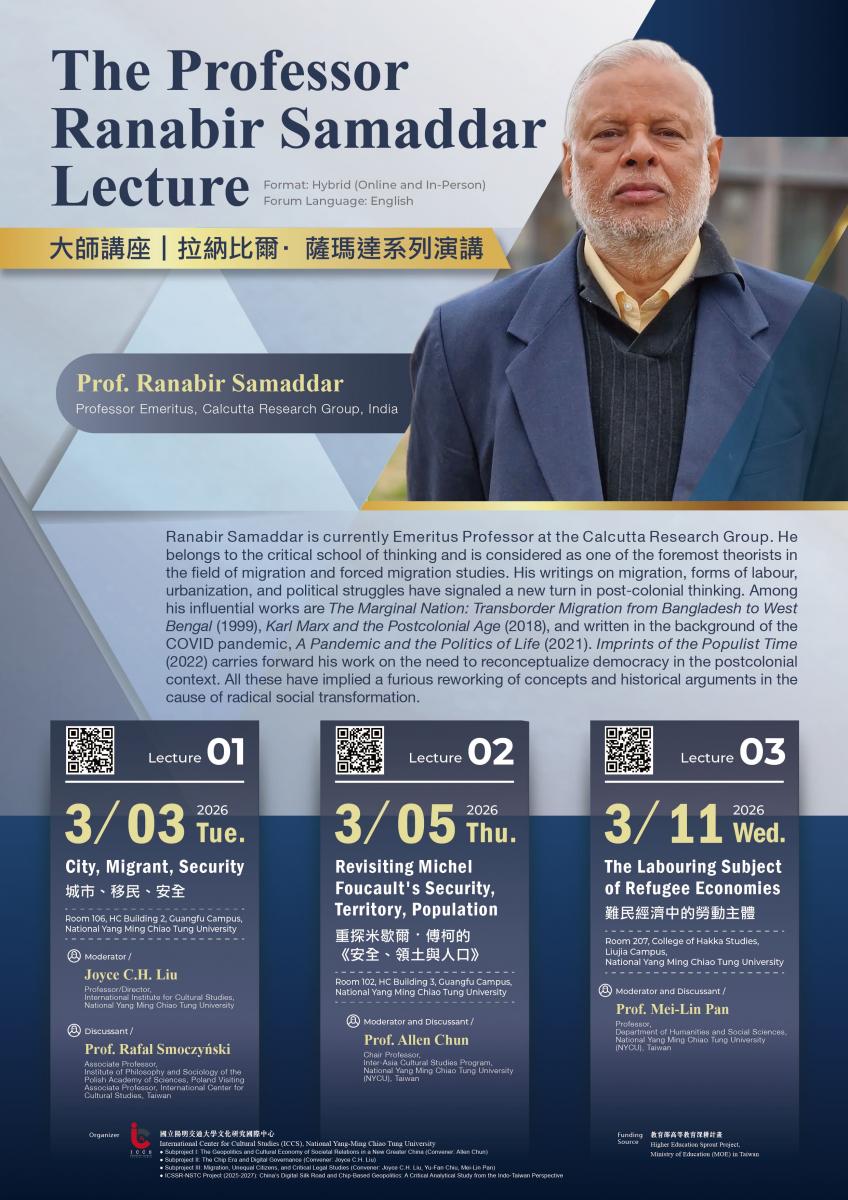
2026-03-03 - 2026-03-03
Ranabir Samaddar is one of South Asia's most preeminent political theorists and post-colonial scholars. His career bridges the gap between radical political practice and high-level theoretical construction, making him a pivotal figure in transitioning "Subaltern Studies" toward the critical examination of "Governance and Migration."
I. Life and Early Experience: From Revolutionary to Intellectual
- Radical Origins: In the late 1960s, while a student at Kolkata’s prestigious Presidency College, Samaddar actively threw himself into the student movement during the height of the Naxalbari Maoist agrarian uprising, venturing into rural areas to organize peasants.
- Imprisonment and Reflection: His involvement in radical politics led to his arrest and imprisonment. This lived experience of "the body against the state" became the profound emotional and empirical foundation for his later research on state violence, biopolitics, and governmentality.
- Founding Research Institutions: He is the founder of the Mahanirban Calcutta Research Group (CRG), which has become one of South Asia’s premier think tanks for the study of refugees, migration, peace, and democratization.
II. Major Works: Mapping the Post-colonial Architecture of Power
Samaddar’s prolific writings consistently revolve around the themes of "how power operates" and "how the masses resist":
- The Marginal Nation (1999): The work that established his international reputation. By examining transborder migration between Bangladesh and India, he challenged traditional nation-state concepts of territorial sovereignty.
- The Postcolonial Age of Migration (2020): In this seminal work, Samaddar argues that "statelessness" and "forced migration" are inevitable products of modern nation-state sovereignty. He exposes how international frameworks of "safe, orderly, and regular migration" often mask deeper logics of population control and discipline. For Samaddar, migration is not a "problem to be solved," but a window into the injustices of the contemporary world.
- Karl Marx and the Postcolonial Age (2018): An attempt to synthesize Marxist political economy with post-colonial theory to rethink labor and class in the Global South.
- A Pandemic and the Politics of Life (2021): Written in the wake of COVID-19, this book analyzes how the pandemic amplified the vulnerabilities of migrant labor and the expansion of state bio-power.
III. Key Contributions: Theoretical Innovation and Turns
- Reconceptualizing Migration and Statelessness: He elevated migration from a demographic issue to a category of political philosophy, proposing that the migrant is not a byproduct of crisis, but the central political subject challenging the core of nation-state sovereignty.
- Post-colonial Transformation of "Governmentality" and "Biopolitics": He adapted Michel Foucault’s theories to the South Asian context, showing how state control over life (biopolitics) often merges with colonial legacies of violence to form a specific "authoritarian route" to democracy.
- The Practical Ethics of "Solidarity and Care": Particularly in his recent work on the pandemic, he emphasizes that when state systems fail, the spontaneous mutual aid networks of the subaltern (the ethics of care) are the true forces sustaining social survival.
IV. International Recognition and Impact
- A Leader in Post-colonial Studies: He is recognized as a key scholar who, following the lineage of Edward Said and Gayatri Spivak, extracts "post-coloniality" from concrete administrative and historical archives.
- A Voice for the Global South: In global debates on refugees and human rights, Samaddar’s "non-Western centric" perspective—especially his redefinition of "illegality" and "citizenship"—is highly regarded by the international academic community.
- Bridging Theory and Action: Beyond being widely cited in international journals, the CRG under his leadership is a key partner for the UNHCR in South Asia, demonstrating the power of theory to influence policy and social justice.

.png)

.jpg)