側記 | 底層研究與後殖民主義有多相容? (I)
2026-11-10
誰有權傾聽?底層研究與知識政治:
「底層研究有多後殖民?論批判性底層主義」(一)論壇紀錄
作者:Kokoro Tomita(中央研究院東亞與現代世界形成國際研究生學程博士生)
2026年10月12日|國立陽明交通大學文化研究國際中心(ICCS)
(中文版為AI自動翻譯)
Near the end of a forum devoted to Subaltern Studies, a familiar question returned in a different form. The issue was no longer simply whether the subaltern could speak, but who could listen. This shift emerged amid increasingly pointed discussions about scholarly authority, the absence of women among the principal speakers, and the distance between academic critique and contemporary political struggles. It also brought into focus a question that had been running through the forum from the beginning: who determines what counts as knowledge, whose experiences become recognizable within it, and who has the authority to interpret them?
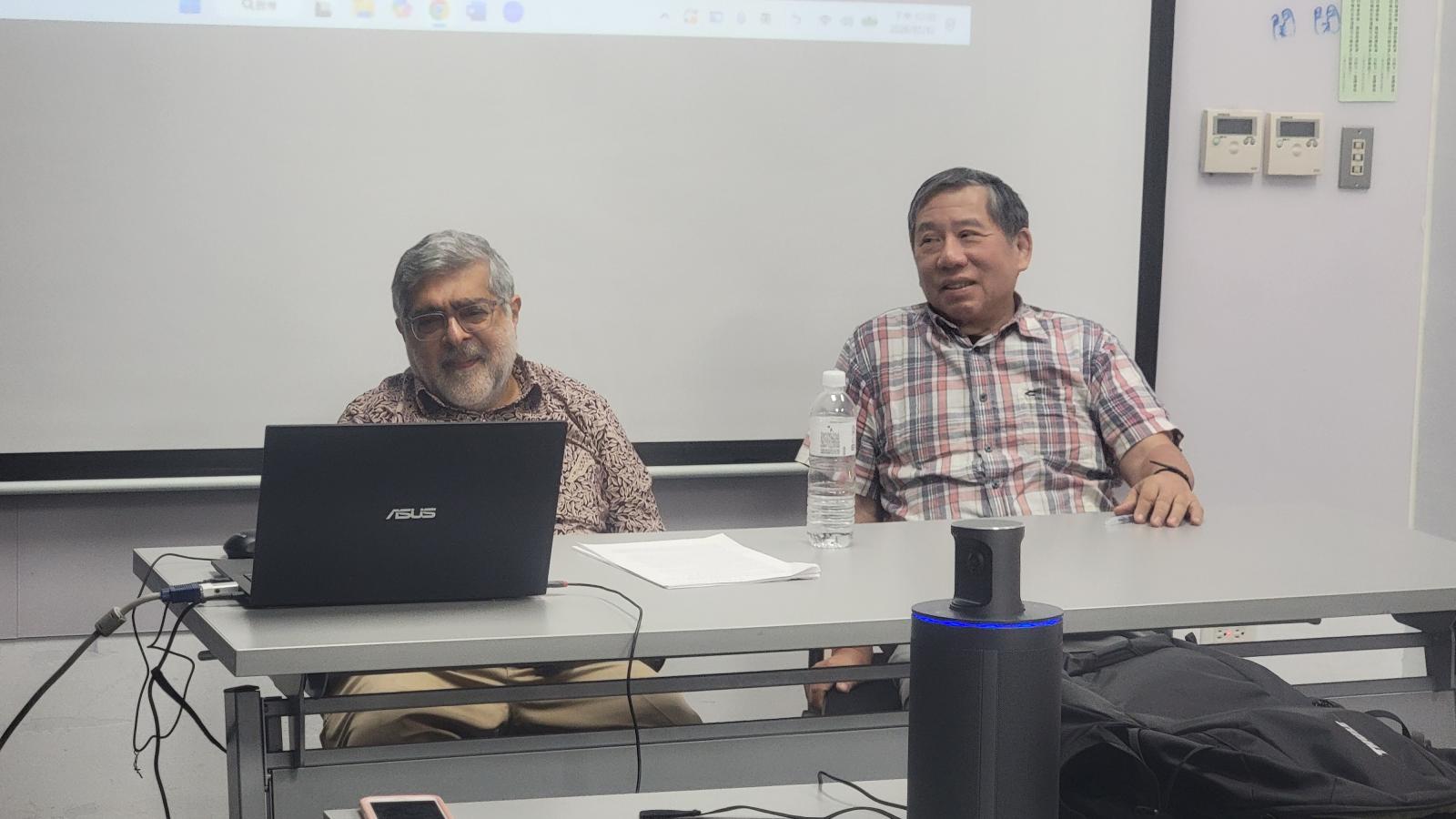
Held on October 12, 2026, the first forum in the series How Postcolonial is Subaltern Studies?, organized by the International Center for Cultural Studies (ICCS) at National Yang Ming Chiao Tung University, brought together Saurabh Dube, John R. Beverley, and Vinay Lal, with responses from John Hutnyk and Chua Beng Huat. Following opening remarks by Allen Chun, the session, entitled On Critical Subalternism, was chaired by Fred Y. L. Chiu.
The forum’s guiding question invited participants to reconsider a relationship often taken for granted. Although Subaltern Studies and postcolonial theory share concerns with colonial power, historical marginalization, and resistance, their intellectual genealogies and political commitments do not necessarily coincide. What began as an inquiry into their relationship gradually became a broader debate about how critical knowledge is produced, institutionalized, contested, and brought into relation with the present. The differences that emerged were not simply matters of disciplinary emphasis. They concerned what constitutes an adequate critique, which histories and political struggles deserve attention, and whether established intellectual frameworks can remain responsive to experiences that challenge their assumptions.
When Critique Becomes Authority
Saurabh Dube opened the discussion by questioning the very categories through which Subaltern Studies and postcolonial critique are commonly understood. In his presentation, “Text, Totem, Texture: On Naming and its Vicissitudes,” he cautioned against reducing heterogeneous intellectual traditions to readily recognizable theoretical labels.
Drawing on Henry Louis Gates Jr.’s “Critical Fanonism,” Dube approached critical subalternism as a challenge to hurried classifications that transform complex bodies of scholarship into intellectual totems: simplified objects of scholarly allegiance, celebration, or dismissal. Such classifications, he argued, obscure the historical circumstances, conceptual disagreements, and diverse practices through which these traditions have developed.
Against these reductions, Dube proposed approaching Subaltern Studies as an emergent archive of the human sciences rather than a unified intellectual school. This requires attention to its internal heterogeneity, alongside its intersections with and departures from postcolonial critique.
Central to his argument was a critique of what he termed modern scholasticisms: modes of knowing that privilege abstract conceptual claims while obscuring their own conditions of possibility. Dube questioned both Eurocentric accounts that universalize particular Western historical experiences and critical approaches that romanticize non-Western difference or resistance as inherently emancipatory. Despite their apparent opposition, these positions may share a tendency to treat power and difference as already understood.
For Dube, confronting these tendencies requires scholars to examine their own investments in intellectual privilege. Rather than positioning power as an external adversary and resistance as its natural opposite, critique must remain attentive to the entanglements of domination, meaning, difference, and dissent that constitute social worlds.
His emphasis on earthly immanence extended this methodological argument. Drawing attention to embodied, affective, and sensuous experiences—including memory, longing, loss, and everyday encounters—Dube questioned approaches that privilege analytical reason over other modes of knowing. These dimensions are not premodern residues awaiting theoretical explanation but constitutive aspects of modern social life.
Modernity itself, he suggested, must be understood through its internal contradictions: reason and race, democracy and colonial expropriation, scientific progress and slavery. His reflections on Ranajit Guha’s intellectual legacy and neoliberal academic culture brought these questions back to the institutions through which critical knowledge is produced and circulated.
What Dube ultimately called into question was the authority of scholarship to stand outside the worlds it describes. If intellectual categories are themselves historically and institutionally produced, then critique must remain accountable not only to its objects but also to its own practices of representation.
Equality and the Possibility of Politics
Where Dube emphasized the conditions of critical knowledge, John R. Beverley asked what political commitments might still be recovered from Subaltern Studies.
In “Subalternism and the Possibility of Politics,” Beverley situated the discussion within what he described as the diminished influence of postcolonial scholarship amid resurgent colonial rhetoric, authoritarian nationalism, and neoliberal globalization. Contemporary conflicts, particularly those involving Gaza and Iran, formed part of his account of a changing geopolitical order.
For Beverley, globalization had complicated inherited understandings of colonial dependency without overcoming the inequalities produced through colonial history. He consequently proposed distinguishing the political emphasis of Subaltern Studies from that of postcolonial critique. While the latter has primarily examined the persistence of colonial relations of power, he argued that Subaltern Studies places relations of equality and inequality more directly at the center of its concerns.
Drawing on liberation theology’s preferential option for the poor, Beverley suggested that Subaltern Studies might provide a political orientation through which colonial domination and internal social hierarchies can be examined together. A postcolonial defense of national sovereignty, for example, would not necessarily address inequalities of gender, class, or other forms of subordination within the nation itself.
His proposal was to recover equality—not only formal equality but also substantive equality—as a central criterion of critical politics. Rather than treating equality as the inevitable consequence of historical progress, Beverley presented it as a political principle through which existing institutions and relations of domination might be challenged.
Perhaps most provocatively, he argued for reconsidering the emancipatory possibilities of liberalism at a moment when authoritarian and illiberal movements increasingly reject its commitments to autonomy, rights, and equality.
The paradox was deliberate. Liberalism developed alongside European colonial expansion and capitalist arrangements that systematically produced inequality; Beverley did not deny this historical complicity. Yet, drawing on Herbert Marcuse, he asked whether an emerging contradiction between capitalist domination and liberal commitments to freedom and democracy might make those commitments politically useful against contemporary illiberalism.
His intervention thus posed a difficult question: what does it mean to defend principles whose historical realization has been inseparable from the forms of domination one seeks to challenge?
Rather than resolving this contradiction, Beverley treated it as a possible opening for political action. His argument introduced a tension into the forum: if critical scholarship cannot escape its implication in the intellectual and political traditions it criticizes, might those traditions nevertheless contain resources for contesting domination?
Whose Past Counts as History?
Vinay Lal’s presentation, “Subalternity beyond Subaltern Studies: History, Postcolonial Theory and the Persistence of Ahistoricity,” approached the limits of established knowledge from another direction: the authority of history itself.
Lal began by questioning dominant narratives of the origins of Subaltern Studies. Responding in particular to Dipesh Chakrabarty’s account in The Routledge Handbook of Subalterns across History, he challenged the emphasis on peasant studies and the influence of the Vietnam War as sufficient explanations for the project’s emergence.
Such accounts, Lal argued, risk overlooking the political circumstances of post-independence India. The disillusionment surrounding democratic institutions, the suppression of radical movements, and the Emergency of 1975–1977 were, in his account, important to understanding the conditions from which Subaltern Studies emerged.
He also raised questions about intellectual contributions marginalized within dominant narratives of the field, including those of Sumit Sarkar and Dalit thinker D. R. Nagaraj.
These omissions raised a question about the politics of intellectual history itself. How does a scholarly project that initially challenged dominant historiography come to establish an authoritative account of its own beginnings? As Lal observed, Subaltern Studies emerged as a project of dissent but subsequently acquired considerable scholarly authority. The relationship between critique and authority was therefore already embedded in its institutional development.
Yet Lal’s argument went beyond revisiting the field’s genealogy. Drawing on Ranajit Guha’s later writings, Rabindranath Tagore, and Ashis Nandy, he questioned the dominance of historiography as the privileged means of accessing the past.
His formulation of the empire of history challenged the assumption that historical recognition must take the form of professional historical discourse. Distinguishing the past from the disciplinary procedures through which it becomes history, Lal pointed toward other ways of apprehending temporality, including literary, religious, and Puranic traditions.
His discussion of the 1992 demolition of the Babri Masjid illustrated the political stakes of these questions. Rather than treating the conflict solely as a dispute between competing historical claims, Lal asked how the demand for historical verification might displace different relationships to sacred traditions and the past.
The point was not simply to replace one authorized history with another. Rather, Lal questioned why historical discourse had acquired the authority to determine which relations to the past could be considered legitimate knowledge.
Here Lal’s concerns intersected with Dube’s critique of established epistemic categories, but their apparent proximity concealed a significant disagreement. While both questioned the authority of dominant ways of knowing, they differed over whether the limits of historical knowledge could be addressed through the plurality of existing historical practices or required a more fundamental challenge to the authority of history itself.
Beyond the Boundaries of the Field
The two discussants extended these concerns from the authority of intellectual categories to the institutions and regional contexts in which they circulate.
John Hutnyk examined how radical intellectual projects become incorporated into universities, publishing markets, and professional academic cultures. Reflecting on the histories of Subaltern Studies and postcolonial scholarship, he questioned how critiques initially motivated by political dissatisfaction could themselves become objects of academic branding and institutional recognition.
Even critical intellectual traditions, he suggested, remain vulnerable to commodification and recuperation within neoliberal academic structures. Drawing on his experience in Vietnam, Hutnyk also questioned how scholars such as Chakrabarty have invoked the “Vietnam War” as an emblem of peasant revolutionary struggle. His concern was not to diminish the agency of peasants, but to challenge how romanticized representations of a complex conflict against the United States and its allies can acquire unexamined authority within scholarly narratives.
His intervention underscored the importance of attending to historical specificity rather than transferring theoretical explanations across contexts without reconsidering their assumptions.
Chua Beng Huat approached the relationship between postcolonial theory and Subaltern Studies through the experience of island Southeast Asia. Despite its extensive colonial histories, the region has occupied a relatively marginal position within canonical postcolonial scholarship.
Chua suggested that this absence was connected to the priorities of post-independence nation-building, economic development, and political stabilization. In societies such as Singapore and Malaysia, rural populations were incorporated into national political and economic structures in ways that complicate the identification of peasants as a coherent subaltern category. Ethnic differentiation, smallholder agriculture, and the movement of labor between rural and urban economies further challenge assumptions derived from the Indian experience.
Yet Chua’s intervention went beyond questioning whether concepts developed in India could be applied elsewhere. He challenged the analytical priority often accorded to colonial continuity itself.
In rapidly transformed societies such as Singapore, he suggested, global capitalism had displaced the continuing sense of being colonized in important respects. Institutions inherited from colonial rule could persist without necessarily remaining the primary reference points through which people understand their present circumstances. The more pressing question for younger generations might concern how to navigate the inequalities and uncertainties of neoliberal capitalism.
Chua’s question—when can colonialism be considered to have ended?—did not deny the continuing influence of colonial institutions. Rather, it unsettled the assumption that colonial history must remain the primary framework through which contemporary social relations become intelligible.
This was a challenge not merely to the geographical reach of postcolonial critique, but to its explanatory priorities. Who determines whether coloniality, capitalism, ethnicity, or another set of relations provides the most illuminating starting point for understanding a particular society?
Taken together, the discussants highlighted a shared difficulty from different directions: how can a critical framework travel across institutional and geographical contexts without transforming its historically situated assumptions into universal categories?
When Critique Becomes a Matter of Disagreement
The subsequent discussion revealed how deeply contested these questions remained.
A particularly pointed exchange developed between Dube and Lal concerning the interpretation of historicality and the relationship between history and myth. Their disagreement also extended to Lal’s treatment of Chakrabarty’s contribution to The Routledge Handbook of Subalterns across History, co-edited by Dube and Ishita Banerjee.
Dube questioned the emphasis placed on Chakrabarty’s contribution, arguing that it neglected the broader intellectual heterogeneity of the volume. He also challenged what he understood as a distinction between Western historical consciousness and non-Western mythic traditions. Drawing attention to scholarship on plural temporalities and embodied, nonverbal ways of apprehending the past, Dube argued that historical and anthropological inquiry had already developed approaches capable of questioning such oppositions.
Lal rejected this characterization. His argument, he insisted, did not rest on a simple division between Western history and non-Western myth. Rather, he sought to distinguish the authority of disciplinary historiography from other modes of relating to the past, including Puranic traditions. He also maintained that Chakrabarty’s published contribution remained a legitimate object of criticism, regardless of its place within the larger collection.
The exchange, at times openly confrontational, revealed more than a disagreement over terminology. Dube emphasized the plurality of historical practices already explored within existing scholarship, while Lal questioned whether such approaches sufficiently unsettled the broader sovereignty of history.
Equally significant was their disagreement over how each position had been represented. A forum concerned with the dangers of intellectual simplification found its participants disputing whether one another’s arguments had been adequately understood.
This tension need not be read simply as a failure of scholarly dialogue. It also demonstrated the difficulty of practicing the reflexive critique that both approaches, in different ways, demanded. How should scholars challenge interpretations they consider inadequate without prematurely determining what another argument means? And what happens when the criteria for an adequate interpretation are themselves contested?
The political stakes of these questions became more explicit as the discussion turned toward the relationship between scholarship and contemporary struggles.
Beverley questioned the apparent distance between the extended theoretical exchanges and urgent political problems. In particular, he drew attention to the absence of women among the principal speakers and challenged the insufficient attention given to the contemporary backlash against feminism and women’s autonomy. His intervention raised a difficult question concerning the limits of critical scholarship: can intellectual traditions committed to challenging subordination remain politically effective when their own institutional practices reproduce exclusions?
Another intervention redirected attention toward contemporary configurations of inequality, including platform labor, migrant and precarious workers, AI-related labor, algorithmic surveillance, and the renewed production of coloniality. Rather than remaining confined to the genealogy of academic traditions, the discussion turned toward the changing material and institutional conditions through which subaltern positions are produced today.
These concerns prompted further reflection on whether established frameworks of Subaltern Studies and postcolonial critique could adequately comprehend the present conjuncture. Lal expressed considerable doubt about their sufficiency, while Dube returned to the distance between scholarly argument and its presumed immediate political consequences, questioning the intellectual entitlement through which academics attribute transformative power to their own interventions.
The closing exchanges brought these tensions into particularly sharp relief. Following the discussion of gendered exclusion, an attempt to create an additional opportunity for a woman
participant to speak prompted concern that such a gesture might become tokenistic without a more fundamental reconsideration of the conditions of participation.
Near the close, the familiar question of whether the subaltern can speak was reframed through the problem of listening.
This moment offered no simple resolution. Indeed, the disagreement over how to respond to exclusion revealed the difficulty of translating a critique of unequal representation into transformed practices of participation.
Yet it also illuminated a question that had traversed the entire forum. If the politics of knowledge concerns who is represented, it must also concern who has the authority to interpret, recognize, and respond to what others say. The presence of a voice does not by itself guarantee that its claims will alter the terms of discussion.
What Would It Mean to Listen?
The forum did not resolve how postcolonial Subaltern Studies is, nor did its participants converge on a shared theoretical or political position.
Dube and Lal disagreed over whether the plurality of historical practices could adequately unsettle the authority of history itself. Beverley proposed recovering liberal commitments despite their historical entanglement with colonial capitalism, leaving open the political risks and possibilities of such a strategy. Chua questioned whether the persistence of coloniality remained the most productive starting point for understanding contemporary inequalities in Southeast Asia.
These disagreements concerned more than disciplinary emphasis or regional variation. They revealed different assumptions about the nature of critique, the authority of historical knowledge, and the political demands of the present.
Rather than treating these tensions as obstacles to be overcome, the forum made visible how difficult it is to remain open to interpretations that challenge one’s own understanding of what constitutes knowledge, critique, and political urgency.
The question of listening acquires particular significance in this context. It cannot mean only being courteous to opposing views, nor can it substitute for political action or institutional change. It also involves examining who defines a relevant question, an acceptable explanation, or a credible account of experience—and whether those definitions can themselves be revised.
Who gets to name an intellectual tradition? Who decides whether a history is legitimate, an interpretation persuasive, or a political concern urgent? And can those who occupy positions of scholarly authority allow the terms of their understanding to be altered by others?
These questions do not eliminate the substantive disagreements that emerged during the forum. Instead, they ask what it would mean to remain answerable to them without reducing their complexity or demanding their resolution within an established intellectual framework.
The forum’s closing question thus offers a way to carry its debates forward. The continuing relevance of Subaltern Studies and postcolonial critique may depend less on preserving their established identities than on their capacity to reconsider the conditions under which knowledge is made, circulated, and received.
Decolonizing knowledge, from this perspective, requires more than making room for additional voices. It also calls for examining the relations of power that determine whose words are recognized, whose questions matter, and who is expected—and able—to listen.
近期新聞 Recent News