民眾在何處?亞際社會的民眾劇場
▍主編
李齊
國立陽明交通大學社會與文化研究所博士生。國立交通大學(
雷智宇(Zikri Rahman)
國立陽明交通大學社會與文化研究所碩士研究生,
劉紀蕙
美國伊利諾大學比較文學博士。
▍攝影
許斌
紀實攝影者。三十多年來,他記錄解嚴後台灣各種現象,
▍開幕之夜策展人
姚立群
劇場製作人、導演。現任牯嶺街小劇場館長、身體氣象館負責人。
▍作者群(依文章篇序)
Glecy Cruz Atienza/菲律賓大學迪里曼分校人文學院專任教授
Muhammad Febriansyah/馬來西亞理科大學(檳城)
安筱霏(Ratu Selvi Agnesia)/雅加達年輕女性劇場研究者
丁東(Dindon W. S.)/「墓地劇團」總監
Richard Barber/博士、劇場工作者、獨立學者
Robin Weichert/東京法政大學教師
區秀詒/「數位荒原」特約作者、吉隆坡「亞答屋84號圖書館」(
Library and Collective)共同創辦人
韓嘉玲/歷史研究工作者、農村教育研究者與行動者
王墨林/劇場導演、行為藝術表演者、文化批評者
鍾喬/劇作家、導演、詩人
阿道.巴辣夫.冉而山/冉而山劇團團長、導演
夏曉鵑/世新大學社會發展所教授
李秀珣/民眾(社區)戲劇工作者、家庭照顧者
吳思鋒/劇評人、澳門《劇場.閱讀》季刊副主編
白大鉉/「SHIIM」的製作人、演員
洪承伊/韓國釜山劇團「劇場外」的表演者
趙川/作家、劇場編導、藝術評論及活動策畫人、民間戲劇團體「
王楚禹/當代藝術家、行為藝術家、策展人
劉馨鴻/2015年後玉泉特訓主要參與者
Assane Alberto Cassimo/「家劇場」(Teatro em Casa)協會的統籌和創始成員
郭亮廷/國立中正大學中文系兼任講師、藝評人及譯者
▍譯者簡介(依文章篇序)
李丁/國立陽明交通大學社會與文化研究所博士生
黃雋浩/國立陽明交通大學亞際文化研究碩士生
吳庭寬/文化工作者
胡明/國立陽明交通大學社會與文化研究所博士生
劉岩/文字與影像作者,研究者,翻譯者
白真松/國立清華大學亞際文化研究碩士生
延光錫/中國浙江海洋大學中文系教師
葉寶儀/國立陽明交通大學社會與文化研究所碩士生
Where are the people? People’s theater in Inter-Asian Societies
▍EDITORS INTRODUCTION
Qi Li
Qi Li is a Ph.D. student in Institute of Social Research and Cultural Studies in National Yang Ming Chiao Tung University. She came to Taiwan out of curiosity, then got a journey full of adventures. Her ongoing projects focus on life stories of the small theater practitioners, the technologies of mobility and governance in contemporary conditions, and the political-economic transitions on both sides of the Taiwan Strait over the last half-century. She writes articles and reviews for independent media and research institutions based in different countries. She was the coordinator of “Where the People Are…Workshop on People’s Theater in Inter-Asian Societies” in December 2018.
Zikri Rahman
Zikri Rahman has consistently embarked on collaborations with educational and cultural activist groups in various socio-political projects through Buku Jalanan, a rhizomatic network of street library movement he co-founded in the year 2011. Operating as a loose cultural and knowledge workers movements, it focuses on decentralizing the modes of knowledge production. Other than that, he is also affiliated with Pusat Sejarah Rakyat, independent archival research and documentation focusing on Malaysia and Singapore’s people’s history. With LiteraCity, he initiated a literary and cultural mapping project in the city of Kuala Lumpur. Currently pursuing his postgraduate studies in Social Research and Cultural Studies in Taiwan, Zikri is also a writer, independent researcher, translator, and podcaster for various ephemeral platforms.
Joyce C.H. Liu
Joyce C.H. Liu received her Ph.D. degree in Comparative Literature in 1984 from the University of Illinois at Urbana-Champaign, USA. Currently, Dr. Liu is the Director of the International Center for Cultural Studies, and a full-time professor at the International Program in Inter-Asia Cultural Studies, and the Director at the National Yang Ming Chiao Tung University. Her research focuses on geopolitics, biopolitics, border politics, internal coloniality, unequal citizens, epistemic decolonization, and artistic interventions. She has published six books, 100 peer-reviewed journal articles, and chapters and coedited nine books. She is leading two ongoing joint research projects: “Conflict, Justice, Decolonization: Critical Inter-Asia Cultural Studies,” awarded by the Ministry of Education, Taiwan (2018-2022), and “Migration, Logistics, and Unequal Citizens in the Global Context” (2019-2022), awarded by CHCI-Mellon Foundation.
▍CURATOR OF THE OPENING NIGHT
YAO Lee Chun
Theater director, producer and festival director, film researcher and curator.The director of Body Phase Studio since 2007 and has been as Director of Guling Street Avant-garde Theatre (GLT) since 2008.
▍PHOTOGRAPHER
HSU Ping
A documentary photographer. Over the past three decades, he has consistently documented the diverse phenomena of the post-Martial Law Taiwan and on/off the stage of modern theaters.
▍AUTHORS
Ratu Selvi Agnesia/A young female theater researcher active in Jakarta.
Glecy Cruz ATIENZA/A Professor at the College of Arts and Letters, University of the Philippines, Diliman, Quezon City.
AU Sow Yee/A guest writer for the online magazine No Man’s Land; Co-founder of Kuala Lumpur’s Rumah Attap Library and Collective.
BAEK Dae-hyun/A producer and an actor for the works of SHIIM.
Richard BARBER/A theater worker and independent scholar working as the co-director of Free Theatre in Melbourne, Australia and advisor to the Makhampom Theatre Group in Thailand.
Assane Alberto CASSIMO/A coordinator and founding member of Associação Teatro em Casa.
CHUNG Chiao/A playwright, theater director, poet, and the artistic director of Assignment Theatre.
Dindon W.S./The Director of Teater Kubur.
Muhammad FEBRIANSYAH/A lecturer at School of Social Sciences, Universiti Sains Malaysia, Penang.
HAN Jia-ling/A history and rural education scholar and activist.
HONG Seung-yi/Currently working at Theater BAKK.
Hsiao-Chuan HSIA/A Professor at the Graduate Institute for Social Transformation Studies, Shih Hsin University.
KUO Liang-ting/An adjunct lecturer at the Chinese Department of National Chung Cheng University.
LEE Show Shin/An artist from community people’s theater and a family care worker.
LIU Hsin-hung/The main participant of Yuquan Training since 2015.
Adaw Palaf LANGASAN/The founder and director of Langasan Theatre.
WANG Chu-yu/A contemporary artist, performance artist, and curator based in Mainland China.
WANG Mo-lin/A theater director, performance artist and cultural critic Robin WEICHERT (Tokyo).
Robin WEICHERT (Tokyo)/A teacher of Hosei University, Tokyo.
WU Sih-Fong/A theater Critic, Associate editor of Performing Arts Forum (Macau).
ZHAO Chuana/A writer, theater maker and curator who creates alternative and socially engaged theater in China. Also, he is the founding member and mastermind of the theater collective Grass Stage since 2005.
▍TRANSLATORS
BAEK Jin-sol/A student of master programme of Inter-Asia Cultural Studies at National Tsing Hua University in Taiwan.
Kris CHI /M.A. of National Central University Department of English.
Victor FUNG Tsz Ching/A freelance translator graduated from Department of English, City University of Hong Kong.
LEONG Jie Yu/A Master’s degree in English Language Studies from the University of Malaya.
LIANG Chun-wen/Graduated from Department of English, National Central University.
LO Chun Yat, Timothy/M.A. of the Institute of Social Research and Cultural Studies, National Yang Ming Chiao Ting University.
Shu-Chuan LIN/M.A. of National Chung Hsing University Department of Foreign Languages and Literatures and freelance translator.
IP Po Yee/M.A. of the Institute of Social Research and Cultural Studies, National Yang Ming Chiao Tung University.
Jonathan S. PARHUSIP/Ph.D. of the Institute of Social Research and Cultural Studies, National Yang Ming Chiao Tung University.
Kin TONG/A translator and researcher on psychoanalysis theory.
The Contested Space of Media in Society
Rethinking the Failed Project of Equality
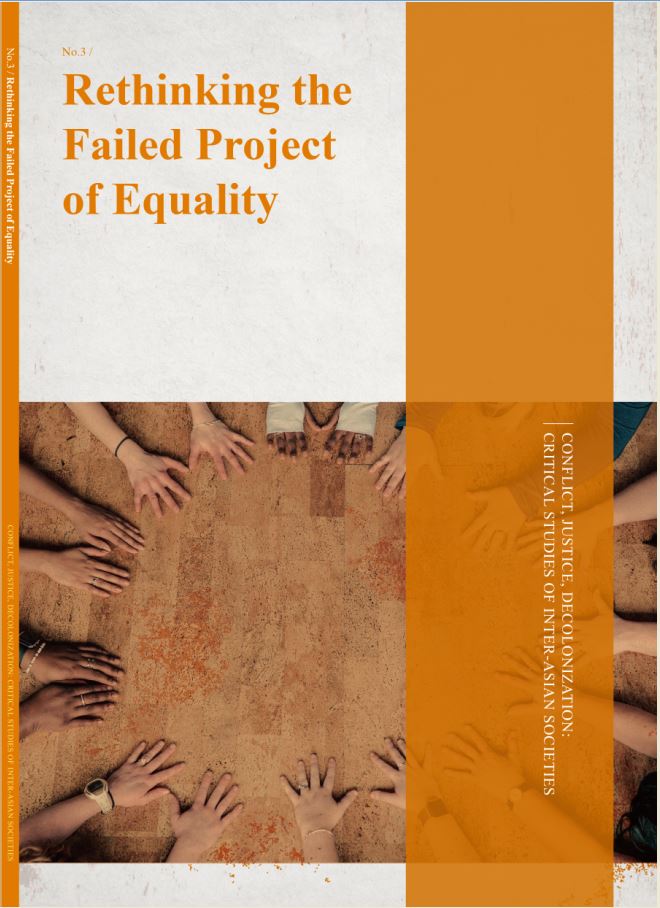
Rethinking the Failed Project of Equality
Introduction
Over the past centuries, we have witnessed emerging insights and projects that attempted to
point out the origins of inequality and to free people from conditions of being enslaved,
exploited, and colonized. Efforts in pursuit of a more equal world widely emerge in many
aspects, such as popular movements, superstructure design, and technological progress.
Modern projects of equality circulated both in the forms of knowledge and practice in a
reciprocal passage between the West and the non-West. For instance, in the post-war age,
when former colonies successively pursued independence, the idea of universal emancipation
in the third world influenced people in the West to fight against global imperialism structure
as well as domestic elite groups. During the late 1960s, in the so-called global ’68
movements, students and workers in different countries protested for equal salary, women’s
rights, liberty, and democracy. Strikes and mass demonstrations inspired intellectual concerns
in specific disciplines like race, gender, labor, and post-colonialism.
The social revolution of the global ‘68 movements eventually faded out in the face of the
domination of the neo-liberalism ideology, the collapse of the Soviet Union, the endless wars
and conflicts in the Middle East, and the centralization of wealth and power around the
world. Idealish welfare systems and social justice have been somewhat achieved in some
high-income countries, however at the cost of increasing labor exploitation and
environmental pollution in offshore developing regions. Currently, the global situation is
worsening as a new wave of populism and racism towards migrants and refugees is rising
everywhere.
This special issue provides diverse observations on the disappointing fact that the
institutionalization of inequalities still dominates our societies. The articles in this issue
covered recent gender issues in Vietnam and South Korea, the capitalist agendas behind the
Rohingya refugees crisis, the rise of white nationalism in the US, transborder migration from
Indonesia to Taiwan and domestic migrant workers in China, the paradox of social
integration and inclusion in the Philippines, and decolonization of knowledge production in
translation from the West to the Sinophone world. With an intellectual background in
humanities, our writings follow the utopian proposition of equality advocated by research of
feminism, post-colonialism, and migration studies. Here lies the entanglement between
knowledge production and social intervention, and our question remains: Is it still possible to
pursue a world of mutual respect and universal equality?
Rethinking the Failed Project of Equality
Table of Contents
1. The #MeToo Movement and the Potential of Feminist Digital Activism Combat
Sexual Harassment in Vietnam
2. Cyber Harassment, Misogyny, and the South Korean Online Sphere
3. Transgression of Female Stereotypes and Empowerment of Women in The Third
Wife
4. The Geostrategic Location of Myanmar and its Influence on the Rohingya Conflict
5. Why has American White Nationalism been on the Rise in Recent Years?
6. Racialized Migration: Indonesian Fishers on Taiwanese Fishing Vessels
7. Freedom to Move, No Freedom to Settle: The Labor Migrancy Dilemma in
Contemporary China’s Urbanization
8. Borders and Museums: Exclusion through Social Inclusion
9. Decolonizing Knowledge: Casals’ Reception Histories in the Sinophone World
within the Global Cold Wat Context
E-book reading: LINK
.jpg)
Social Movements in a World of Backsliding Democracy
Pandemic Politics: Disruption and (Re)action